
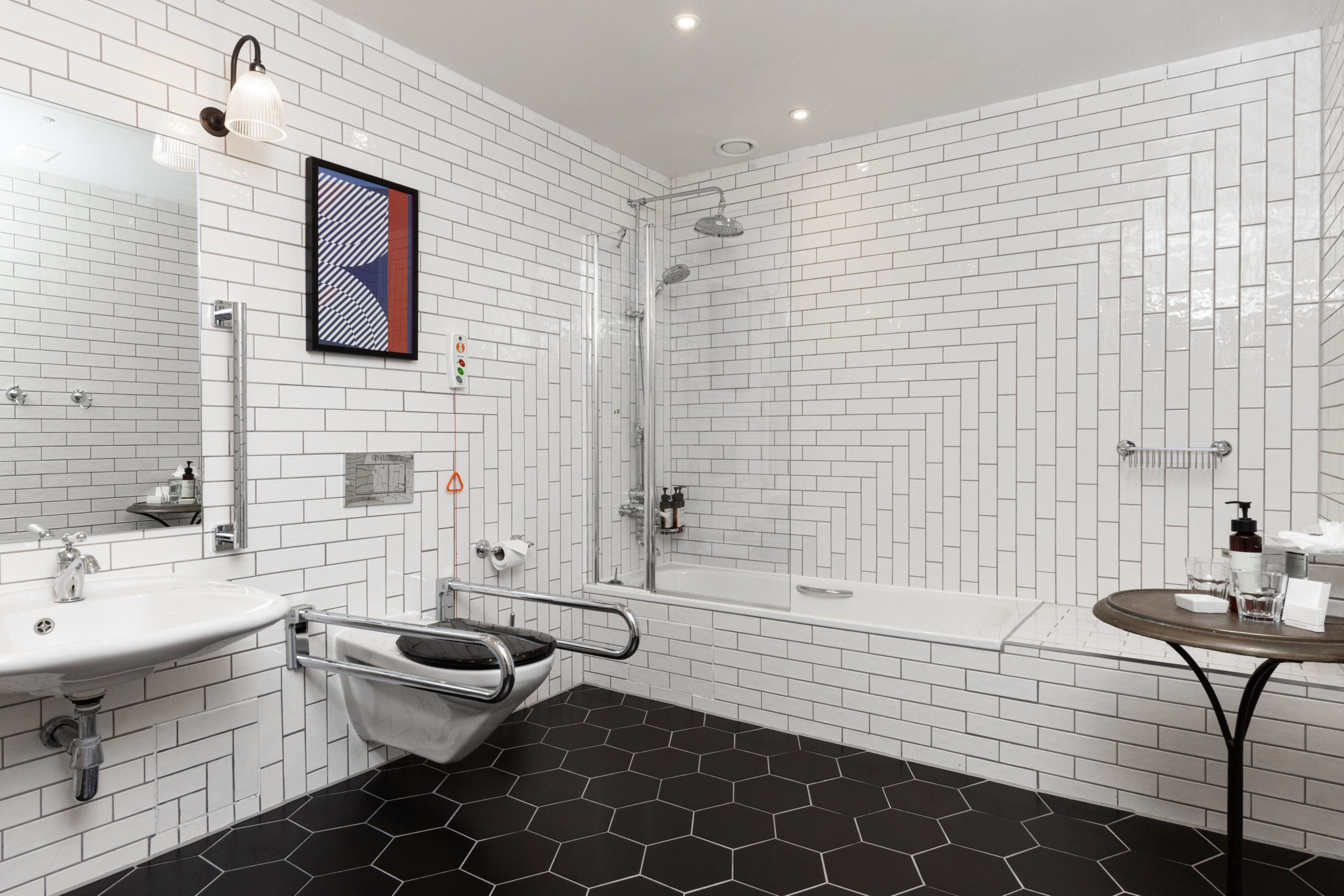
The room where luxury hotels reveal what they really understand about disability
Luxury hotels are quick to tell you they have an accessible bathroom.
Far fewer can tell you exactly who it works for.
That’s because accessibility isn’t one experience.
And the bathroom is often the room where a hotel’s understanding of disability becomes impossible to hide.
Luxury hotels spend extraordinary amounts of time thinking about bathrooms.
The marble is chosen carefully. The brassware has a story behind it. The lighting is designed to flatter. The toiletries are curated. Somewhere, somebody has debated the height of the mirror, the scent of the bath products and whether the rainfall shower delivers exactly the right experience.
Bathrooms matter because they say something about the hotel long before anyone has unpacked.
They tell you whether you’re expected.
They tell you how the property defines comfort.
They tell you whether someone has thought beyond appearances.
Which is why I find accessible bathrooms so fascinating.
Not because I spend my life reviewing grab rails.
Not because I enjoy measuring turning circles or counting centimetres.
But because this is where beautiful design meets the private reality of somebody’s body.
I’ve stayed in extraordinary luxury hotels where the service was impeccable, the restaurants exceptional and the bedrooms beautifully designed, only to discover a bathroom that quietly suggested nobody had ever imagined a disabled guest actually using it.
I’ve also stayed in hotels where the accessible bathroom wasn’t trying to be different at all.
It simply worked.
The difference between those two experiences isn’t usually budget.
It isn’t star rating.
It isn’t even age.
It’s understanding.
And understanding is far harder to install than another grab rail.
The assumption hidden inside almost every accessible bathroom

Hotels often talk about having an accessible room.
Singular.
One room. One bathroom. One answer.
On paper, that can sound reasonable.
Until you ask the question that sits underneath this entire conversation.
Accessible for whom?
A wheelchair user who transfers independently may need clear space beside the toilet and support in a very particular position. Someone who uses a ceiling hoist needs an entirely different relationship between the bed, bathroom and transfer space. A guest with one-sided weakness following a stroke may depend upon fittings being available on one side rather than the other.
For somebody who is blind or partially sighted, contrast, lighting and a predictable layout may matter more than the amount of floor space. A person living with dementia may need a room that feels calm and intuitive. Someone managing a stoma, catheter or continence condition may be thinking about hygiene, storage and discreet disposal rather than whether the shower is technically level access.
Then there are ambulant wheelchair users, guests with chronic pain, people whose balance or dexterity has changed with age, and those whose disability isn’t visible at all.
These aren’t small variations on the same experience.
They are different bodies, different routines and different ways of moving through a deeply private space.
There is no single global figure for the number of people who need an accessible hotel bathroom, because “accessible” isn’t one measurable requirement.
The scale of the audience, however, is impossible to dismiss.
The World Health Organisation estimates that 1.3 billion people experience significant disability worldwide. That is 16% of the global population, or roughly one person in every six.
In the UK, the latest Family Resources Survey estimates that 16.7 million people are disabled, equivalent to one in four of the population. Mobility impairment is reported by a significant proportion of disabled adults, but the need for a thoughtfully designed bathroom extends beyond mobility alone. It may relate to balance, pain, fatigue, dexterity, vision, continence, personal care or the use of specialist equipment.
At the more complex end of the spectrum, the Changing Places Consortium estimates that well over 250,000 disabled people in the UK require facilities beyond those provided by a standard accessible toilet, including additional space, an adult-sized changing bench and a ceiling hoist.
Not every one of those people needs a roll-in shower.
Not every wheelchair user needs the same transfer space.
And not everybody who would benefit from an accessible bathroom identifies themselves as disabled when making a booking.
That is precisely the point.
Hotel bathrooms are still frequently designed around one imaginary disabled guest who is expected to represent everybody else.
That guest doesn’t exist.
What the law requires, and what luxury should require of itself
Building standards matter.
Without them, many disabled guests would have even fewer options than they do now.
In England, Approved Document M provides guidance on how building work can meet the access requirements of the Building Regulations. For hotels, it states that at least one wheelchair-accessible bedroom should be provided for every 20 bedrooms, or part thereof. Those rooms should be located on accessible routes, offer an equivalent standard of amenity and include suitable en-suite bathroom or shower facilities.
That doesn’t mean every existing hotel is automatically required to rebuild itself around one prescribed layout. The age of the property, the nature of the building work and the regulations applying within each UK nation all matter.
The Equality Act 2010 creates a separate responsibility. Hotels and other service providers have an anticipatory duty to consider disabled guests and make reasonable adjustments. They are expected to think about potential barriers before an individual guest encounters them, rather than waiting until somebody arrives and discovers that the experience doesn’t work.
BS 8300 sits alongside these requirements as a code of practice, offering broader recommendations for accessible and inclusive design. It is an important benchmark for good practice, but it isn’t legislation in itself.
Together, these frameworks provide a necessary foundation.
But a foundation isn’t the finished experience.
Compliance can establish whether somebody should technically be able to use the space.
Luxury hospitality should be asking whether they can use it safely, privately and without turning an ordinary routine into a negotiation.
Can somebody relax here?
That is an entirely different standard.
Because luxury has never been defined by whether something is technically possible.
Luxury removes work.
It removes uncertainty and friction.
It allows the guest to stop thinking.
Disabled guests deserve exactly the same thing.

When the equipment is right, but the placement is wrong
Few pieces of equipment have become as symbolic of accessibility as the stainless steel grab rail.
They’re essential.
They’re also wildly misunderstood.
A grab rail isn’t accessible because it exists.
It’s accessible because it’s in the right place for the person using it.
I’ve seen toilets with rails positioned beautifully…
…for somebody who transfers from the left.
Meaning somebody transferring from the right is left improvising.
Some wheelchair users pivot.
Some stand briefly.
Some slide.
Some need support on both sides.
Stroke survivors may only have functional use of one arm.
Someone living with hemiplegia may require an entirely different arrangement from someone with paraplegia.
Yet hotels still describe bathrooms simply as “accessible”, as though one layout automatically works for everybody.
It doesn’t.
That’s not criticism.
It’s reality.
The bath that quietly disappeared
One assumption appears repeatedly across luxury hospitality.
If a room is accessible, remove the bath.
Install a roll-in shower.
Job done.
Except that many disabled people love baths.
Some rely on them.
Warm water eases muscle spasms.
It helps manage chronic pain.
It allows joints to move more freely.
It provides relief after travelling.
For some neurological conditions it offers one of the few moments each day where the body properly relaxes.
Of course many wheelchair users cannot use a bath safely.
Many can.
Others travel with equipment that allows them to.
Others transfer independently.
Others would simply like the choice.
Luxury has always been about choice.
Pillow menus.
Dining preferences.
Spa treatments.
Arrival experiences.
Yet the moment disability enters the conversation, choice often disappears.
The hotel decides what the disabled guest needs before the disabled guest has had the opportunity to decide for themselves.
Bathrooms are where medical reality arrives
Luxury marketing is understandably aspirational.
The photographs show marble, soft lighting, beautiful toiletries and steam rising from an immaculate bath.
They rarely show the practical reality that may arrive in the guest’s luggage.
Disability can travel with catheter and stoma supplies, continence products, transfer boards, pressure cushions, portable hoists, leg braces, wound dressings, respiratory equipment and medication that must be stored safely. None of those things make a stay less luxurious. They are simply part of the person arriving.
Yet the bathroom may offer nowhere suitable to place supplies, dry equipment or manage personal care discreetly. A partner or personal assistant can find themselves balancing essential items around the sink because the room has been designed as though additional equipment will never enter it.
That matters because disability doesn’t disappear when somebody checks into a five-star hotel.
They have simply paid more in the hope of experiencing the same ease and dignity as everybody else.

The compromises nobody puts in the brochure
When an accessible bathroom doesn’t work, the outcome isn’t always a complaint at reception.
Often, the compromise happens quietly.
The guest may decide not to book at all because the information is too vague to risk it. They may choose the hotel but accept that they won’t be able to bathe or shower properly during the stay. A few days away can mean washing at the basin, relying more heavily on a partner or personal assistant, or reducing a private routine to whatever is possible with wipes and a towel.
In some hotels, a guest who cannot use the toilet in their room may have to travel through the building to reach the accessible toilet near reception. That may technically provide access to a toilet. It doesn’t provide the privacy, independence or dignity expected from an en-suite bedroom.
Others shorten the stay.
Some go home.
Some simply don’t travel again.
The hotel team may be kind. The service elsewhere may be exceptional. Staff may genuinely want to help.
But goodwill cannot turn an unusable shower into a usable one.
And no amount of warmth at reception compensates for being unable to use the bathroom attached to the room you have paid for.
This is where the language of “minor inconvenience” becomes particularly unhelpful.
For a non-disabled guest, an unsuitable bathroom might be disappointing.
For a disabled guest, it can determine whether the stay is possible at all.
The language matters more than hotels realise
Perhaps the biggest problem isn’t always physical.
Sometimes it is the language surrounding the room.
“Accessible”, “adapted”, “wheelchair friendly”, “mobility room” and “special access” may all sound reassuring, but they are labels rather than descriptions. They tell the guest what the hotel believes about the room. They don’t explain how the room will work.
What matters is the detail beneath the label.
A guest may need to understand whether the shower seat is fixed or removable, whether there is a lip at the entrance, how high the toilet is and which side offers transfer space. They may need to know whether the basin has seated clearance beneath it, whether there is room for somebody to assist, whether a portable hoist can be used and whether the emergency cord reaches the floor.
Presented as a long technical inventory, that information can feel clinical.
Presented clearly, with photographs and context, it becomes reassurance.
The irony is that hotels often provide greater detail about their pillow menus than about the bathrooms on which some guests’ ability to stay depends.
That usually isn’t because they don’t care.
It is because they haven’t been shown what confidence looks like from the guest’s side of the booking journey.
One bathroom can never serve everyone
This is perhaps the most uncomfortable conversation hospitality needs to have.
There is no such thing as a universally accessible hotel bathroom.
There never will be.
Some guests require a ceiling-track hoist.
Others need a bath.
Some need a fixed shower seat.
Others find fixed seats become obstacles.
Someone transferring from the left has entirely different requirements from someone transferring from the right.
For a guest with a visual impairment, colour contrast may matter more than grab rails.
For someone living with dementia, clear layouts and intuitive design may determine whether the space feels calming or confusing.
Parents travelling with an adult disabled son or daughter have different needs again.
As do couples.
As do solo travellers.
As do younger wheelchair users compared with older guests whose needs have changed gradually over time.
That isn’t failure.
It’s simply humanity.
The answer isn’t to design one perfect bathroom.
The answer is to stop pretending one bathroom can represent everyone.
Information is part of accessibility
Hotels sometimes ask me what I would change.
My answer isn’t always physical.
Sometimes I would change the website.
No hotel bathroom will work perfectly for every person. That isn’t a realistic standard, and pretending otherwise doesn’t help the guest or the hotel.
But perfection isn’t what disabled travellers are asking for.
They are asking for enough honest information to decide whether the room works for them.
VisitBritain cites AccessAble’s 2023/24 Accessibility and You Survey, which found that 95% of disabled people check accessibility before visiting somewhere new, while 87% expect that information to be available on the venue’s website.
That is the commercial cost of uncertainty made visible.
The answer doesn’t need to be a page of labels or another list of conditions the hotel believes it can accommodate.
A clear floor plan, honest photographs, a few useful measurements and a short video can explain far more. The hotel can state whether support equipment is fixed or portable, whether bath and shower options are available across different rooms, and whether additional equipment can be supplied or hired locally.
It can also say, without embarrassment, what the room doesn’t provide.
That honesty matters.
A hotel doesn’t need to claim that its bathroom is accessible to everybody.
It needs to describe what is there accurately enough for each guest to make their own decision.
The strongest accessibility information doesn’t tell somebody that a room will work for them.
It gives them the confidence to know for themselves.
The hotels quietly getting it right
One of the biggest myths in hospitality is that accessible design somehow makes a room feel clinical.
It doesn’t.
Poor design makes a room feel clinical.
Thoughtful design simply feels… considered.
I’ve seen hotels integrate accessible bathrooms so naturally that unless you needed the additional features, you might barely notice them.
The materials remain beautiful.
The lighting remains warm.
The shower still feels indulgent.
Nothing about the experience asks the guest to choose between accessibility and luxury.
That distinction matters.
Because disabled guests aren’t looking for special treatment.
They’re looking for equal quality.
There are encouraging examples across the industry.
Several luxury hotel groups have begun moving beyond minimum compliance by considering wider circulation space, discreet support features, better visual contrast and more detailed pre-arrival information.
Properties investing in Changing Places facilities are beginning to recognise that some guests simply cannot travel without them.
Meanwhile, organisations such as Changing Places Consortium continue to demonstrate that true inclusion often depends on facilities far beyond what traditional accessible toilets provide.
Progress is happening.
It’s simply happening unevenly.
That thinking is beginning to appear within luxury hospitality. At Park Hyatt London River Thames, Fitzroy of London worked with the hotel, developer and design team to create accessible bathrooms that sit naturally within the property’s contemporary aesthetic. Removable support features allow the space to be adapted around different guests, rather than treating one fixed arrangement as the answer for everyone.
It’s a reminder that accessible design doesn’t have to compete with luxury.
When it’s considered from the outset, it becomes part of it.


The Majestic Hotel & Spa Barcelona, a member of The Leading Hotels of the World, goes further still for guests with more complex physical requirements.
Its adapted room includes a ceiling hoist above the bed, alongside remotely controlled doors, windows and bed functions, while retaining the character and aesthetic of the wider hotel.
That last part matters.
The hoist hasn’t been treated as something incompatible with luxury, or as equipment that somehow lowers the tone of the room. It’s there because, for some guests, transferring safely isn’t an additional preference. It’s what makes the stay possible.
A hoist may serve a smaller number of guests than a grab rail or level-access shower.
For the person who needs it, however, its absence is absolute.
There is no improvising.
No assistance from a well-meaning member of staff that can safely replace it.
No amount of exceptional service, beautiful marble or thoughtful lighting can compensate for the fact that the guest cannot get into bed.
The Majestic’s example doesn’t suggest that every hotel bathroom or bedroom must contain every possible piece of equipment. It demonstrates something more important.
Luxury design can accommodate complex physical requirements without asking the guest to surrender atmosphere, beauty or dignity in return.
Bathrooms reveal culture
Whenever I review a hotel, I’m obviously looking at the room.
But I’m also looking at something much less tangible.
Culture.
Did somebody think about this because regulations required it?
Or because they genuinely imagined the guest?
Bathrooms answer that question remarkably quickly.
A thoughtfully positioned shelf beside the sink.
Enough room for medical supplies.
Hooks at usable heights.
A mirror that works from seated and standing positions.
Towels that can actually be reached.
Staff who know what equipment exists without disappearing to ask three different departments.
None of these things are expensive.
They’re signs of curiosity.
And curiosity is one of the most valuable qualities a luxury hotel can possess.
Because curious teams keep asking:
“What might somebody else need?”
Compliance asks whether the room passes.
Curiosity asks whether the guest can exhale.
Why this matters commercially
Luxury hospitality has become increasingly interested in removing friction from the guest journey.
While other guests are deciding between the restaurant and room service, disabled travellers may still be calculating whether they can reach the sink, transfer safely, fit their wheelchair beside the toilet and manage their medical supplies with dignity. Every unanswered detail creates effort. Each unnecessary telephone call delays the booking, and every uncertainty makes another hotel easier to choose.
The commercial opportunity isn’t simply attracting more disabled travellers.
It’s making the hotel easier to choose.
Uncertainty doesn’t.
And in luxury hospitality, ease has always carried value.
The bathroom isn’t really the story
It would be easy to finish by saying hotels need better accessible bathrooms.
They do.
But that isn’t really what this article has been about.
It’s been about imagination.
The ability to picture a guest before they arrive.
To understand that disability is not one experience but millions.
To recognise that dignity is designed long before somebody reaches the bathroom door.
Bathrooms simply make those assumptions visible.
Because this is the thing about accessible bathrooms.
The best ones don’t make me feel like a disabled guest.
They make me feel like a guest.
And that has always been the point.
The most luxurious accessible bathroom I’ve ever used wasn’t necessarily the one with the finest marble.
It was the one that made me realise somebody had imagined me before I arrived.
Luxury is often described as giving people more.
A bigger suite.
A better view.
Finer linen.
More attentive service.
I don’t think that’s quite right.
The very best luxury gives people less.
Less uncertainty.
Less effort.
Less explaining.
Less compromise.
For disabled travellers, the accessible bathroom is where that promise is either fulfilled or quietly broken.
Because the question was never whether the bathroom was accessible.
The question has always been:
Accessible for whom?
The Standard | by Luiz Faye


Leave a Reply