
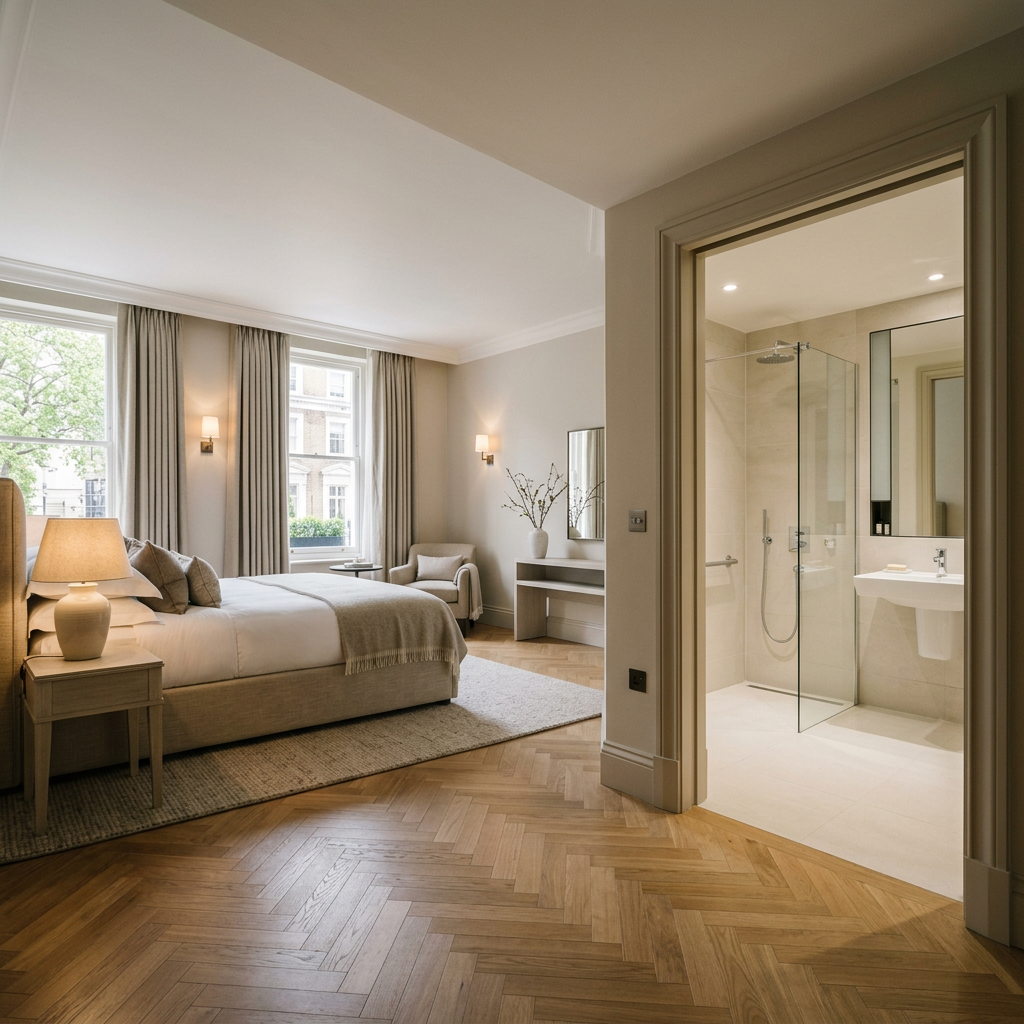
Five luxury London hotels, one two-night business trip and a simple test of what “book direct” means for a wheelchair user.
Hotels have spent years teaching us that booking direct is the smarter way to stay. The hotel’s own website should offer the clearest choice, the best understanding of its rooms and the most confident route to a reservation.
I was looking for one room for one person: two nights in London for work. I use a wheelchair. That was the full brief.
For this particular trip, I didn’t need adjoining rooms, family arrangements or a complicated itinerary. I simply needed to know which bedroom would work, see enough detail to judge it and book it with confidence. It ought to have been exactly the sort of request a luxury hotel website could handle beautifully.
What followed wasn’t really a search for an accessible room. The rooms existed. It was a search for the route to them.
Being able to call a hotel is service. Having to call before I can even understand its room inventory is something else.
About This Edit
I began on each hotel’s own website, as hotels consistently encourage guests to do, and followed the public booking journey for a two-night London business stay. I looked for four things: whether I could find an accessible bedroom, understand its relevant features, see it within the available room choices and select it without leaving the direct booking path.
This is not a physical access audit and it is not a judgment on whether one room will suit every wheelchair user. Access needs are individual. It is a snapshot of the information and booking experience available online in September 2026. It records what a guest could find, understand and book without starting a separate enquiry. I have deliberately left rates aside here; the question is whether the product can be found and booked before we ask what it costs.
Where the direct route was unclear, I also cross-checked Hotels.com and Trip.com. This was not a second hotel comparison. It was a check on whether a mainstream intermediary made the accessible inventory easier to identify.
In An Accessible Bathroom for Whom?, I wrote that information is part of accessibility. This search applies the same principle to the booking journey itself.
The Ned: The Room Is Allowed to Be a Room
The Ned offered the cleanest journey of the five. Its website has a page simply called Accessible Bedrooms. The language is direct, the room feels part of the hotel rather than an appendix to it, and the booking engine labels it plainly as an Accessible Room.
The description gives a useful starting point: rooms range from 23 to 40 square metres, with a queen-size low-level bed, an assistance alarm and accessible bathroom furniture and fittings. The design story remains present too. Wallpaper, pattern, marble mosaic and full-size Cowshed products all appear in the description. Access has not replaced the hotel’s personality in the copy; it sits alongside it.
Most importantly, I could move from reading about the room to seeing it in the booking journey and on towards checkout. There was no need to guess which standard category might secretly contain the accessible version, and no instruction to begin again by email.
There is one detail I would still confirm. The page says bathrooms contain either a rainforest shower or a low-level bath, but the booking step I saw didn’t identify which version would be allocated. For many guests that distinction decides whether the room works at all. The route is excellent; the final piece of certainty should travel with the booking.

Royal Lancaster London: Visible, Practical and Part of the Inventory
Royal Lancaster London also made the accessible room visible in a way that felt refreshingly ordinary. In the booking results it appeared alongside Classic, Deluxe and Executive rooms, with its own name, image, dimensions and rate-selection button. I didn’t have to infer accessibility from a symbol or choose a standard room and hope a note in the comments box would transform it.
The room itself is 31 square metres, the same size as the hotel’s Executive Room, and is described as a double or twin with a wet-room-style bathroom, walk-in shower, pull-down seat, grab rails and emergency alarm cords in the bedroom and bathroom. It is larger than the entry room categories for a practical reason, but it is still presented as an Accessible Room, not as a suite or a special indulgence.
The hotel also links to a detailed AccessAble guide. That independent guide records four accessible bedrooms with wheel-in showers, adjoining-room options and portable hoists on request. The hotel’s own accessibility page adds that a mobile hoist can be provided at no extra charge, subject to availability. Together, those sources provide considerably more than a wheelchair icon.
There is a small inconsistency worth smoothing out. The room page tells guests to book by phone or email, while the booking results I saw allowed the Accessible Room to be selected online. The direct journey worked, but the words around it should agree about whether contact is required.
The Langham: Excellent Information, Then a Missing Bridge
The Langham is an interesting contradiction because its accessibility information is among the most detailed. The website lists clear widths around the bed and through the bedroom and bathroom doors, a roll-in shower, grab bars, shower seating, a handheld showerhead, knee clearance at the vanity and desk, and visual and audible alarm features. The same details also appear within the hotel’s Deluxe Room page.
That detail had already made an impression on me. I included The Langham in an article about accessible luxury hotels in London in January because it offered the kind of practical information that creates confidence before arrival.
The brand also carries some personal context. My review of The Langham Melbourne explains why that 2018 stay helped set the standard behind The Inclusive Edit. Its accessible room felt integrated, considered and unmistakably luxurious. That experience is relevant here because I already know what thoughtful accessible luxury can feel like within the same brand.
The difficulty came when I tried to turn that confidence into a booking. I could read what an accessible bedroom might contain, but I couldn’t find a way to select or book one through the online reservation system. The information and the transaction seemed to live in separate worlds.
The hotel may be able to resolve that quickly by phone or email. That isn’t the question I set out to answer. I wanted to know whether I could understand and book the accessible room through the direct website without beginning a separate enquiry. I couldn’t.
Good accessibility information builds confidence. If it stops before availability and booking, it has only completed half the journey.
Sofitel London St James: One Hotel, Several Versions of the Answer
At Sofitel London St James, the challenge was not a total absence of information. It was fragmentation.
The property website’s rooms overview presents the hotel’s bedrooms and suites beautifully, but it did not give me an accessible-room filter or a clear view of which categories were adapted. A separate Studio Suite page is indexed as wheelchair accessible, while the Accor group website states that the hotel has nine rooms designed for guests with reduced mobility and describes accessible bathrooms with grab bars and roll-in showers. In the booking route I followed, the clearly identified accessible option was a Studio Suite.
Then a recent independent review by accessible travel writer Carrie-Ann Lightley showed a spacious accessible twin room with clear routes beside the beds, a level-access shower, fold-down seat, grab rails and an accessible toilet. It looked like a different room and category from the suite presented in the booking path.
Each piece of information may be accurate on its own. Together, though, they left a very ordinary booking question unanswered: what are the nine accessible rooms, and which of them can I actually choose online for my stay?
The hotel may be able to explain the categories quickly through a separate enquiry. But that isn’t the same as presenting them within the direct booking journey. The issue here is not that the hotel appears to lack provision. It is that its own digital channels do not yet assemble that provision into one coherent answer.

The Londoner: When a Third Party Knows More Than the Direct Site
The Londoner’s own website confirms in its FAQs that accessible rooms are available and asks guests to enquire when booking. Its rooms and suites pages describe the standard categories in detail, but I couldn’t find an accessible bedroom page, an accessibility filter or a room marked as accessible within the direct booking results.
On specialist booking platform Wheel the World, the picture was much clearer. It identifies an accessible Deluxe King City View Room and lists a roll-in shower, shower seat, grab bars and a bed hoist among the features. The platform also builds confirmation of the accessibility into its booking process.
That specialist knowledge is valuable. It is also a revealing reversal of the direct-booking promise. The hotel’s own site told me that accessible rooms exist and invited me to enquire; a third party told me which room, what it contained and how the access would be confirmed.
The Londoner is widely reported to have unusually thoughtful physical provision, including accessible bedrooms and rooms with ceiling-track hoists. That makes the absence more striking, not less. This does not look like a hotel with nothing to say. It looks like a hotel whose digital sales journey has not caught up with the product it already has.
The Third-Party Fallback Was Not Dependable
The cross-check on Hotels.com and Trip.com did not offer a reliable escape route. Neither platform showed me a clearly bookable accessible room at The Langham or The Londoner. Royal Lancaster London’s Accessible Room, which was visible on the hotel’s own website, was not identified as bookable on either platform.
The Ned’s accessible room appeared on Hotels.com but not on Trip.com. Sofitel carried a discreet wheelchair symbol within its suite details on Hotels.com, but no meaningful explanation of what was adapted. I found no equivalent indication on Trip.com.
That inconsistency reinforces the case for getting the hotel’s own journey right. A third party may occasionally surface the room, but it cannot be assumed to hold the complete or most intelligible version of the hotel’s accessible inventory.
The Difference Between Human Service and Compulsory Intervention
None of this is an argument against speaking to a hotel. A thoughtful reservations team can ask the questions a booking engine cannot, confirm the exact layout and make a good stay better. For some guests, that conversation is reassuring and preferable.
The distinction is choice. A phone call can feel like luxury when it adds care. It feels rather different when it is the only doorway to information, availability or the room itself.
A non-disabled business traveller can compare rooms late at night, make a decision in ten minutes and receive written confirmation immediately. When the accessible inventory is hidden, the wheelchair user has to pause, find the correct contact details, explain what they need, wait for a reply and then work out whether the room being discussed is the same one they have seen elsewhere. The task may still be completed, but the direct journey is no longer equal in independence, pace or certainty.
For the hotel, this is more than an accessibility-page problem. It is product information, service design and conversion. Every guest sent away from the booking engine is a direct booking placed at risk. Every avoidable enquiry also creates work for reservations teams who could be using their time to provide genuinely personal service.
What Good Direct Booking Looks Like
The strongest websites in this search did not attempt to predict every individual access need. They did something more basic and more useful: they acknowledged the accessible bedroom as real hotel inventory.
- Make it visible. List the accessible bedroom as a named category or provide a clear accessibility filter within the same room search.
- Describe the room that will be reserved. Include the details that change usability: bath or roll-in shower, transfer space, bed height and clearance, door widths, alarms, hoist provision and adjoining options. Support them with useful photographs or a floor plan.
- Keep the information and the transaction together. A detailed access page should lead directly to availability, while the booking engine should lead back to the relevant room detail.
- Carry certainty into the confirmation. If rooms vary, the guest should be able to select the version required or receive explicit written confirmation of the essential features.
- Offer human help without making it compulsory. Contact with a knowledgeable team should deepen the service, not substitute for the basic ability to find and book the room.
Where the Standard Begins
Across these five searches, The Ned came closest to a complete digital journey. Royal Lancaster London also kept its accessible room visible within the ordinary booking inventory, supported by useful detail, although its instruction to contact the hotel could be aligned more clearly with what the booking engine allows.
The Langham showed how impressive access information can still stop short of a reservation. Sofitel London St James demonstrated the uncertainty created when the property website, group booking platform and independent evidence each reveal a different part of the picture. The Londoner appeared to have strong accessible provision, yet a specialist intermediary offered more booking confidence than the hotel’s own site.
There may be excellent people behind every one of these websites, ready to answer the phone and make the stay work. The point is not to dismiss that service. It is to ask why a disabled guest has to unlock it before they can perform the ordinary act of choosing a room.
Luxury is often described through anticipation: knowing what a guest might need before they have to ask. Online, that begins with clarity. It means allowing a wheelchair user to browse with the same freedom, understand the product with the same confidence and decide when, or whether, they would like help.
The accessible room is already part of the hotel. It should be part of the booking journey too.
Sources
- The Ned: Accessible Bedrooms.
- Royal Lancaster London: Accessible Room.
- Royal Lancaster London: Accessibility.
- AccessAble: Royal Lancaster London guide.
- The Langham, London: Accessible Facilities.
- The Langham, London: Deluxe Room accessibility detail.
- Sofitel London St James: Rooms.
- Accor: Sofitel London St James.
- Carrie-Ann Lightley: accessible twin room at Sofitel London St James.
- The Londoner: Rooms & Suites.
- The Londoner: FAQs.
- Wheel the World: The Londoner accessible room listing.
- Hotels.com, booking search observed September 2026.
- Trip.com, booking search observed September 2026.
Research snapshot: September 2026. Hotel websites and booking engines can change; this article reflects the public journey available at the time of research.
Leave a Reply