
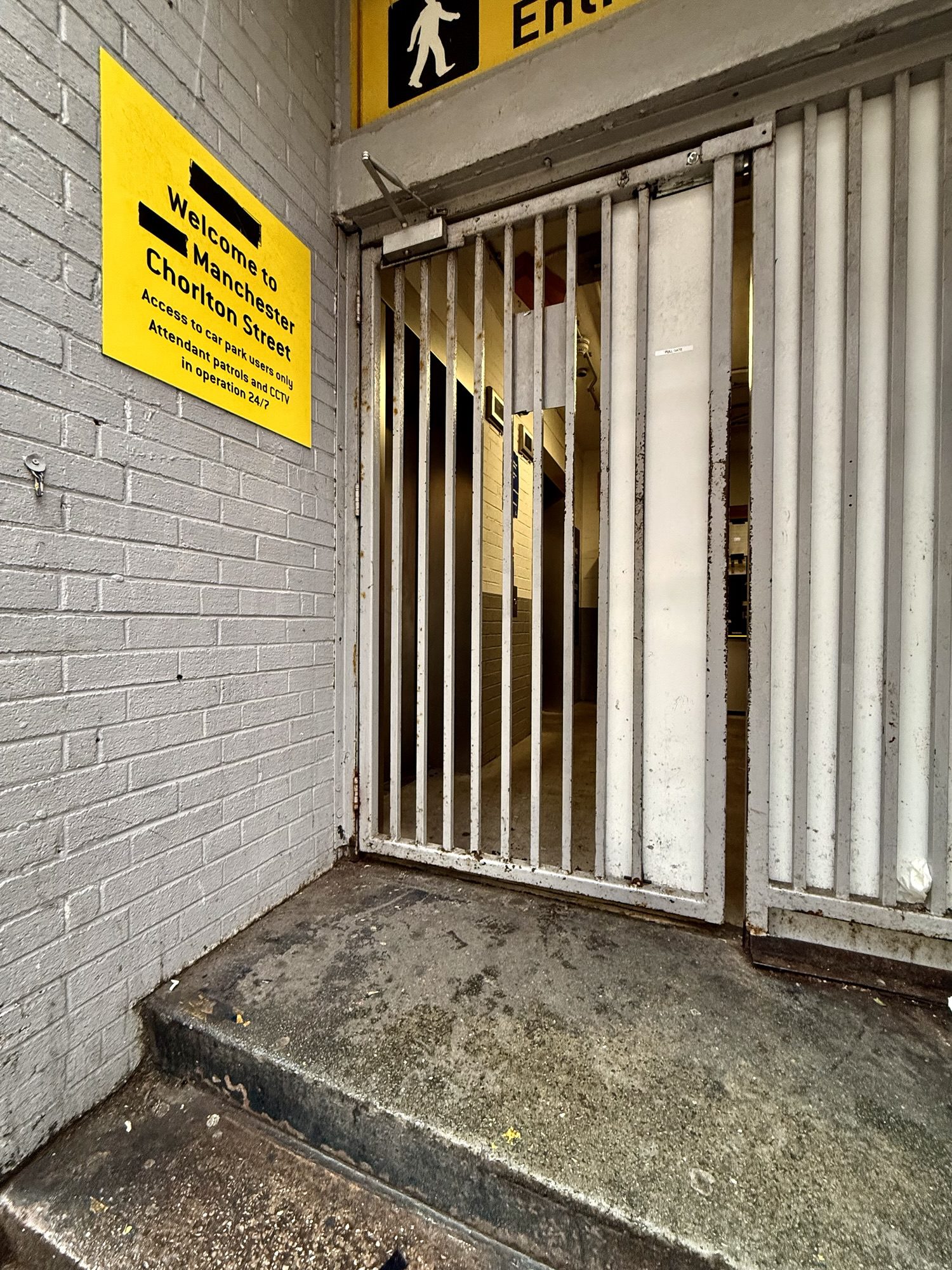
A broken lift at Manchester Chorlton Street left me rolling down a vehicle exit ramp in my wheelchair, only to find two steps at the bottom. A few weeks later, the British Parking Awards showed me just how much goes into making a car park work. It also left me wondering why accessible parking excellence isn’t being celebrated in its own right.
“There’s a chance I’ll end up as flat as a pancake at the bottom.”
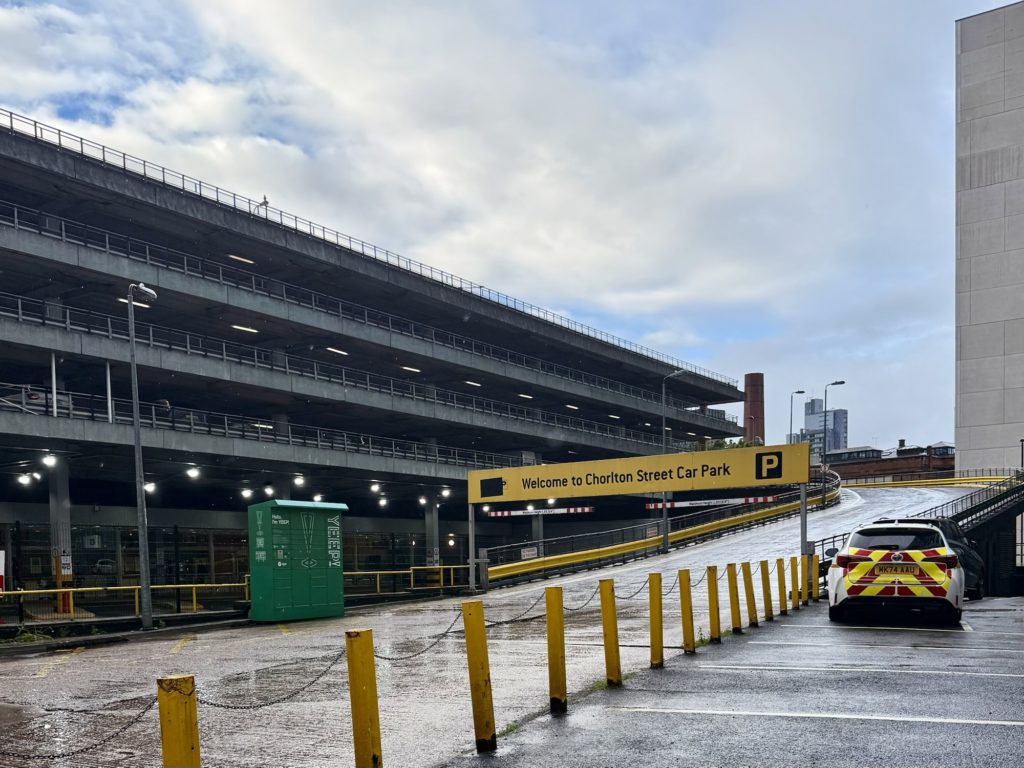
That was my response when the attendant at Manchester Chorlton Street car park told me the lift was out of service and I’d need to use the ramp where the cars leave.
He laughed. I laughed.
Sometimes that’s what I do when a situation is a bit ridiculous and I still have to find a way through it.
Martin and I had parked there during a recent Manchester trip, before we realised there were public Blue Badge bays directly outside LEVEN, where we were staying.
When we discovered the lift wasn’t working, I asked the attendant how I was supposed to get out in my wheelchair.
He told me it was the only lift and pointed us towards the vehicle exit ramp. So Martin walked behind me and down we went.
We reached the pedestrian exit at street level, where the lift came down, and found two steps. There was no ramp.
Martin went back to get the car.
We got out. But I still couldn’t tell you whether we got out the way we were supposed to.
The bit I still don’t know
It would be easy to make this story entirely about those two steps. They do rather command your attention when you’re in a wheelchair.
What has stayed with me, though, is the question of what should have happened.
There may have been another genuinely step-free exit somewhere, but if there was, even the attendant didn’t know about it. Or the lift may have been the only step-free route available when we parked. I still don’t know which it was.
Either way, they had our tenner for what turned out to be a five-minute stay and a fair bit of inconvenience.
I contacted NCP first. It replied promptly and explained that it no longer operated the car park. It directed me to Apex Parking, which now lists Chorlton Street on its website.
I wrote to Apex with a detailed account of what happened; asking what the intended step-free route was, whether the lift formed part of it, what wheelchair users should do when it was unavailable and whether travelling down the vehicle ramp was an approved alternative.
I also offered to share my photographs and video so the company could investigate.
Apex didn’t respond before publication.
So I can tell you exactly which route we took. I can’t tell you which route the operator intended us to take, and I’m not going to fill that gap with a guess.
The information available before arrival only answers part of the question. Apex’s Chorlton Street page gives opening hours, tariffs and the vehicle height limit. I couldn’t find an explanation there of the step-free pedestrian route or what to do if the lift isn’t working.
That doesn’t prove an alternative route didn’t exist. It does mean I couldn’t identify one from the information provided, and we weren’t shown one on the day.
A disabled bay is only the beginning
When we talk about accessible parking, the conversation often begins and ends with the bay.
Is there one? Is it wide enough? Can somebody open the door and get their wheelchair out?
All of that matters. But the bay is only the point at which one part of the journey ends and the next begins.
There’s the surface beneath you, the space around the vehicle, the payment system, the signage, the pedestrian route, the lift or ramp, the exit onto the pavement and the journey back to the car. There’s also the information available before somebody arrives and the response when one part of the route stops working.
A wheelchair symbol painted on the floor doesn’t complete any of that.
The Equality and Human Rights Commission’s code of practice is helpful here because it treats parking areas, lifts, steps, entrances and exits as physical features that can all affect access. The duty to make reasonable adjustments is anticipatory, although what is reasonable will always depend on the circumstances.
I’m not making a legal finding about Chorlton Street. I’m making a much simpler point: access has to continue beyond the bay.
Luxury guest experience doesn’t begin at hotel reception. It begins with whether you can make the journey, arrive, park and reach the destination safely and with some idea of what to expect.
Then I went to the British Parking Awards
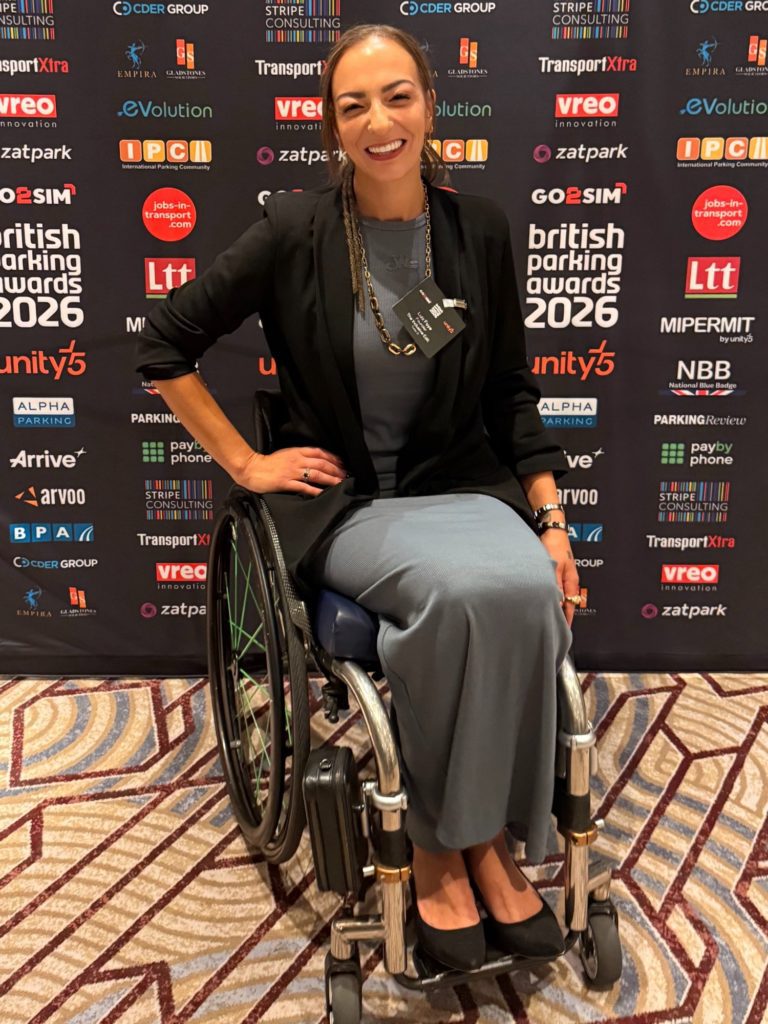
A few weeks later, I found myself at the British Parking Awards at the Royal Lancaster London as a guest of Disabled Motoring UK.
Hosted by comedian Angela Barnes, it was quite the occasion. The room brought together people from across the industry to celebrate 25 years of the awards and the work happening throughout parking.
I’ll be honest: until I became more involved in disabled motoring, I hadn’t fully appreciated how much sits behind a car park.
The awards covered physical design, surfaces, traffic flow, payment technology, communication, enforcement, EV charging, renovation, customer service, community work and the people working on the front line and behind the scenes.
What became very clear was how rarely any of that work belongs to one organisation.
Local authorities work with operators. Software providers support enforcement and communication. Designers, engineers and contractors shape how a space works. Frontline staff deal with what happens on the day, while back-office teams manage the systems that sit behind them.
Across the industry, partnership isn’t an added extra. It’s how improvement happens.
The range of finalists and winners also changed the way I thought about my experience in Manchester. A car park can look like a fairly simple piece of infrastructure until you start examining all the decisions that make it safe, understandable and usable.
And, importantly, what happens when one of those decisions meets real life and something fails.
The moment I knew they had won
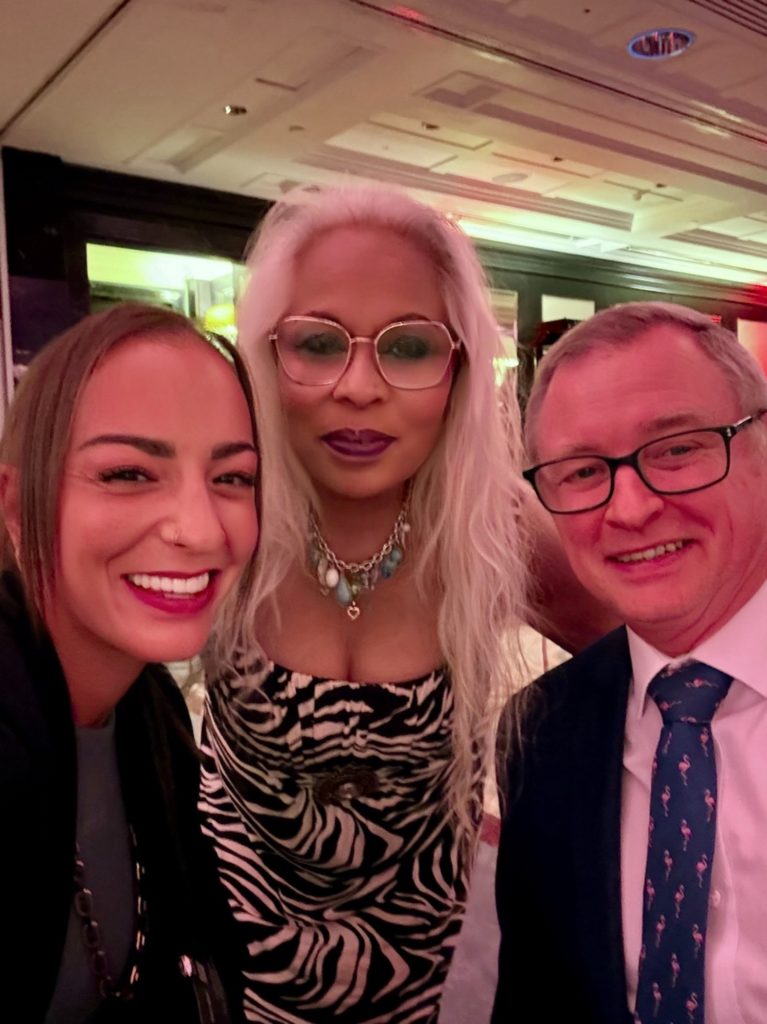
I was sitting with Graham Footer, chief executive of Disabled Motoring UK, when the EVolution Award was announced.
Graham genuinely didn’t think they were going to win.
Then the announcer began describing the project.
DMUK trustee Anjna Patel and colleague Zoe Rush had driven an electric vehicle from England through France to Spain and back, examining what long-distance EV travel actually involved for a disabled driver. They looked at the practicality and accessibility of charging, but also the reliability of the infrastructure and the safety concerns faced by women and disabled motorists travelling through unfamiliar places.
As the details were read out, I had a feeling they’d won it.
All the finalists were brilliant, but this project seemed to encompass everything I would need to consider before attempting a journey like that myself. It didn’t ask only whether a charger existed. It looked at whether somebody could find it, reach it, operate it, pay for it and feel safe while using it.
Anjna and Zoe travelled nearly 3,000 miles and audited charging points across three countries. Their findings covered bay size, heavy cables, controls and screens, payment, digital interfaces, obstacles, lighting, shelter, support and security.
Then Disabled Motoring UK was announced as the winner of the EVolution Award for the Accessible EV Road Trip.
It felt thoroughly deserved.
The award I think was missing
Accessibility wasn’t absent from the British Parking Awards. It appeared within the EV categories, the criteria for new car parks and several projects involving Blue Badge enforcement and disabled motorists.
There is also a Safer Parking Accessible accreditation, through which individual car parks can be assessed against a recognised accessibility standard.
But there wasn’t a Best Accessible Car Park award.
And, honestly, I reckon there should be one.
Not because access should be placed in one neat category and forgotten everywhere else. It should run through design, communication, technology, enforcement, maintenance and customer service.
But a dedicated award could make excellent accessible parking visible. It could show what happens when the whole disabled-driver journey has been considered, from finding useful information before leaving home to getting safely from the car to the street and back again.
It could also ask the question that matters when something goes wrong: what is the contingency?
Back to those two steps
I came away from the Awards with a much greater understanding of the parking industry and the work being done to improve the experience.
I also came away more certain that accessible parking cannot be measured by the presence of a disabled bay alone.
At Chorlton Street, the lift was unavailable. I was directed down a vehicle ramp. The route we took ended at two steps, and the current operator never explained what should have happened instead.
There’s some irony in the fact that the parking solution we needed was sitting outside LEVEN all along. But the next wheelchair user entering Chorlton Street may not be staying at LEVEN. They may not have somebody with them who can walk back up for the car either.
I can laugh about nearly becoming a Manchester pancake.
What I still can’t do is tell another wheelchair user how they’re supposed to get out of that car park when the lift isn’t working.
And that is why a disabled bay is only the beginning.
Reporting note: Apex Parking was invited to respond before publication and offered access to the photographs and video from the visit. No response had been received when this article was published. The linked information was checked on 22 September 2026. If Apex provides further information about the intended accessible route, this article will be updated.
Continue exploring
This article forms part of The Standard, where The Inclusive Edit examines travel, transport and guest experience against the standards they set themselves.
Read more about Motability in 2026, or continue exploring Access Manchester.
Luxury travel reviewed against the standard it sets itself.

Leave a Reply