“You know what? I’ll just get an Uber there and back.”
That was the thought I had while trying to arrange a night in Leeds. I’m going for dinner in December and wanted to make a little more of it: somewhere lovely to stay, a room with a bath and parking that would work for me. The hotel was supposed to be part of the treat.
I like choosing a hotel. Looking through the photographs, imagining a slow morning, deciding whether a particularly gorgeous room is worth spending a little more on. I want to see the bathroom, picture myself settling in and have something to look forward to. Being a wheelchair user doesn’t make me any less interested in those things. It just means there are a few more details I need before I can press book.
So I started looking at Malmaison, Dakota, Hotel Indigo, The Queens, Quebecs and The Chambers. Six different versions of a lovely Leeds stay, but finding out which might work for me took rather more than browsing their rooms.
Choosing a room I can actually see
At Malmaison Leeds, I could browse the rooms and suites, but couldn’t identify a separate accessible category. The brand’s FAQs direct accessible enquiries and bookings to reservations. Once I emailed, the picture became much clearer: the team explained that there are accessible rooms with wet rooms or showers over slightly lowered baths, set out the nearby parking options and gave me a rate.
It was a helpful reply, with the kind of practical detail that makes a decision easier. I just wished I could have started with more of it on the website, alongside the photographs that had drawn me in.
Dakota does offer an accessible selection online, although finding it means choosing a Classic room and moving on to the extras. There, alongside breakfast, sparkling wine and flowers, is an “Accessible Room” option. I’d want to understand the room and its bathroom before choosing it, but that stage didn’t give me a separate accessible-room gallery or explain the bathroom layout.
Again, the people supplied what the booking journey hadn’t. Dakota described its Classic Double Accessible Room with a low bath and overhead shower, distinguished it from a Deluxe Suite that wasn’t an accessible room, and followed up with Blue Badge parking options. There was care in that correspondence. Bringing more of that knowledge into the room presentation would make it easier to choose with confidence.
Hotel Indigo has a more visible route through IHG’s booking system, where an accessible filter leads to a named “1 King Standard Accessible” category. The details describe a wider door, roll-in shower and grab rails. Yet the gallery I saw contained a single image labelled “Premium King”, with no bathroom photograph to help me picture the layout.
The team’s email confirmed that its accessible rooms don’t have baths and identified nearby parking. That answered my particular question, although a guest looking for a shower would still benefit from seeing the bathroom before booking.
Baths are, of course, a personal preference. What matters is being able to understand the choices. The Queens explained that its accessible rooms have different bathroom arrangements, including wet rooms, accessible baths and walk-in showers. It also supplied thoughtful guidance on parking and the route from the station to the accessible entrance.
Its email said I could book online and add a request for my preferred bathroom, while its access statement directs guests to contact the hotel for allocation. A bathroom request still leaves me wanting confirmation of what I’m reserving. When that detail determines whether a stay will work, it needs to be clear before the booking feels settled.
And where a note asking for an accessible room is the only route, I’m not sure I’d book at all. What if that room is already booked? Would I make a reservation, perhaps pay for it, and then wait for someone to contact me to confirm whether my request is possible?
Until that’s confirmed, I don’t have the peace of mind of knowing I’ve actually booked the room I need.
Quebecs has useful detail in its access statement, including bedroom and bathroom measurements, level-entry showers and parking arrangements. Its team confirmed that the accessible rooms don’t have baths and explained the possibility of reserving an ordinary parking space for a Blue Badge holder from check-in. The room information lists accessible rooms as available on request. There’s knowledge there to help a guest decide, but it takes more searching than simply browsing a room.
With The Chambers, I could look through the apartments, kitchens and living spaces, but couldn’t identify an explicitly accessible category in the booking results. My written questions about the apartment, bath, parking and rates brought an invitation to call.
I haven’t got time for that. And, honestly, I don’t want to have to. If three properties responded that way, three emails would become three phone calls before I’d even decided where I wanted to stay. I’d rather spend that time in the bath, frankly.
Leeds hotel booking at a glance
| Hotel | Accessible category to select | Accessible room images | Accessible room description | Online booking option |
|---|---|---|---|---|
| Malmaison Leeds | Not found | No clearly identified gallery found | Enquiry guidance in FAQs; room detail supplied by email | Reservations team |
| Dakota Leeds | Checkbox after choosing a Classic room | No separate gallery at the selection stage | Brief checkbox text; bathroom detail supplied by email | Yes, via extras; room allocation needs clarification |
| Hotel Indigo Leeds | Yes, through IHG’s accessible filter | One image labelled “Premium King”; no bathroom image | Yes, including room size and access features | Yes, named accessible category |
| The Queens | Not found in the searches checked | Not verified | Yes, in a separate access statement | Hotel says book online and add a bathroom request; confirmation needed |
| Quebecs | Listed as on request | Not verified | Yes, detailed access statement | Direct online route not verified |
| The Chambers | Not found | No clearly identified accessible gallery found | No accessible category description found in the booking results checked | No accessible option identified; team invited a call |
Based on the website and booking checks on 16 November 2026. “Not found” means it wasn’t identified in those checks. Images refer to photographs clearly identified as the accessible room, rather than general hotel photography.
When the room is lovely but the booking hides it
One of the best accessible rooms I’ve stayed in was at LEVEN in Manchester. Our Living Space had a generous wet room and a freestanding bath in the bedroom. The design, atmosphere and pleasure of being there were every bit as much a part of the room as its practical features.
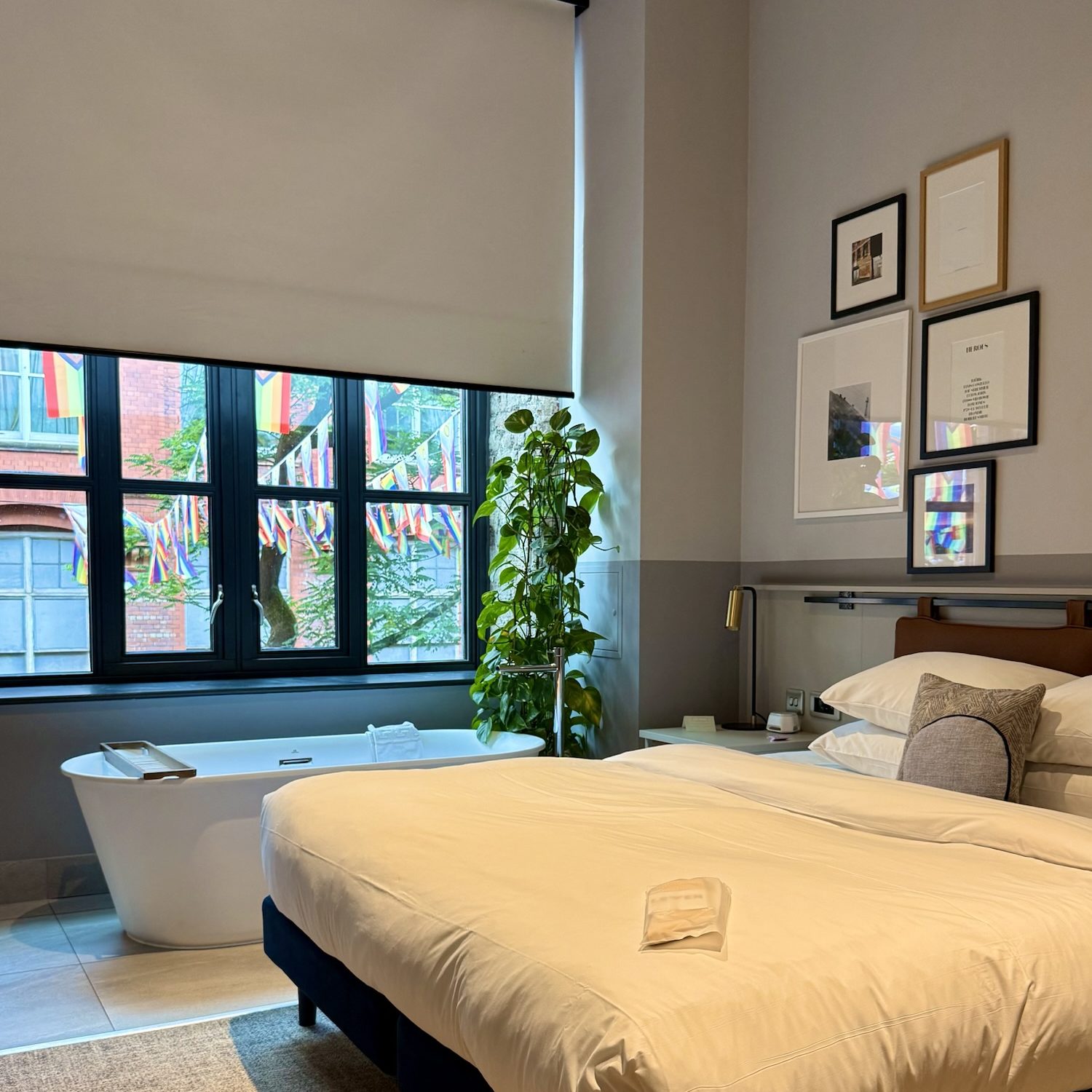
Yet LEVEN’s management actively chooses not to advertise the accessible rooms for online booking. A room I’d happily return to isn’t one I can simply discover and reserve in the same way as the rest of its accommodation.
That matters, because an excellent room can still be overlooked if the people who would love it can’t see it. LEVEN shows why we shouldn’t assume that an absent accessible category means the room itself is a lesser experience. Sometimes the experience is wonderful and the decision about how to sell it is what needs questioning.
Elsewhere in Yorkshire, there are examples of a more inviting approach. Saltmoore presents its accessible room as part of Saltmoore House, with its own description, images and an online availability route. The room’s character sits alongside the practical bathroom features, so a prospective guest can begin to imagine the stay.
Grantley Hall also gives its accessible room a dedicated page, gallery and Book Now route. Its marble bathroom, underfloor heating and pillow menu belong in the same description as the wet room and roll-in shower. They’re all part of what a guest is choosing.
Neither is in Leeds, but both are useful Yorkshire examples of accessible accommodation being given a place within the hotel’s main offer.
Hotels are very good at helping us imagine a stay. We can picture ourselves enjoying their signature dish, choose flowers for the room and arrange for Champagne to be waiting when we arrive. All lovely. I’m very much in favour.
But for me, imagining the stay also starts with a few practical questions. Will my wheelchair fit down the side of the bed? Is there enough room to position it beside the shower seat or loo? Can I transfer from either side, or does the layout only allow one?
Leaving those questions unanswered suggests too little thought has gone into how a disabled guest would actually use the room, and what they’d need to know before booking.
I want to see the light, the décor and the actual bathroom, with photographs, measurements and layout details that help me understand how I’d move around it. That’s what lets me begin looking forward to the stay, right down to where I’ll be enjoying that Champagne.
Where that presentation is missing, why? Has photography never become a priority? Is the booking system making it difficult to show different layouts? Is there a decision to keep accessible rooms out of the main marketing? And if the room doesn’t match the standard shown elsewhere, why doesn’t it?
How much custom never reaches reception
The World Health Organization estimates that one in six people worldwide experiences significant disability. Access requirements vary, but that scale should give hotels reason to consider how many prospective guests their booking experience is serving.
If someone can’t find the information they need, see the room they might stay in or reserve it with confidence, how much custom disappears before the hotel even knows it was being considered?
Some guests will email. Others may choose somewhere else, shorten a trip or decide that staying overnight is more effort than it’s worth. A hotel may never hear why the booking didn’t happen. And when someone is travelling with a partner, family or friends, their decision can influence where the whole group stays.
There’s a longer relationship at stake too. VisitEngland highlights the loyalty of disabled travellers, who often return to places they know work for them. It makes sense to me. Once you’ve found somewhere you can relax, with a room that suits you and people you trust, there’s real pleasure in returning without having to work everything out again.
A hotel could be losing the first night of a relationship that might otherwise last for years.
I’ve written before about booking accessible luxury hotels in London, and this Leeds search brought me back to the same feeling: I want the pleasure of choosing to be part of my stay.
There were thoughtful people answering my enquiries, and I appreciated their help. A conversation can add something lovely when it builds on a room I’ve already seen and understood. It’s harder to enjoy when I need it just to establish what’s on offer.
I’m a spur-of-the-moment kind of girl. If I get a travel idea at 10 pm on a Sunday night, I want to be able to book it there and then.
This piece began with Leeds, but I can’t tell you how many hotels have lost my custom because I couldn’t simply click and book.
I haven’t committed to anything yet. I still rather like the idea of a lovely room and a long bath, although that Uber remains tempting.
Which one would you book?
Luiz x
Website and booking observations checked on 16 November 2026. Room and parking details also draw on the hotels’ written replies.
Related articles: Yorkshire hotels with accessible bathrooms; Gluten-free dining in Yorkshire; Tattu Leeds restaurant review; Rudding Park spa stay; RSPB Old Moor; and Spa Garden at Iveridge Hall.
Leave a Reply