
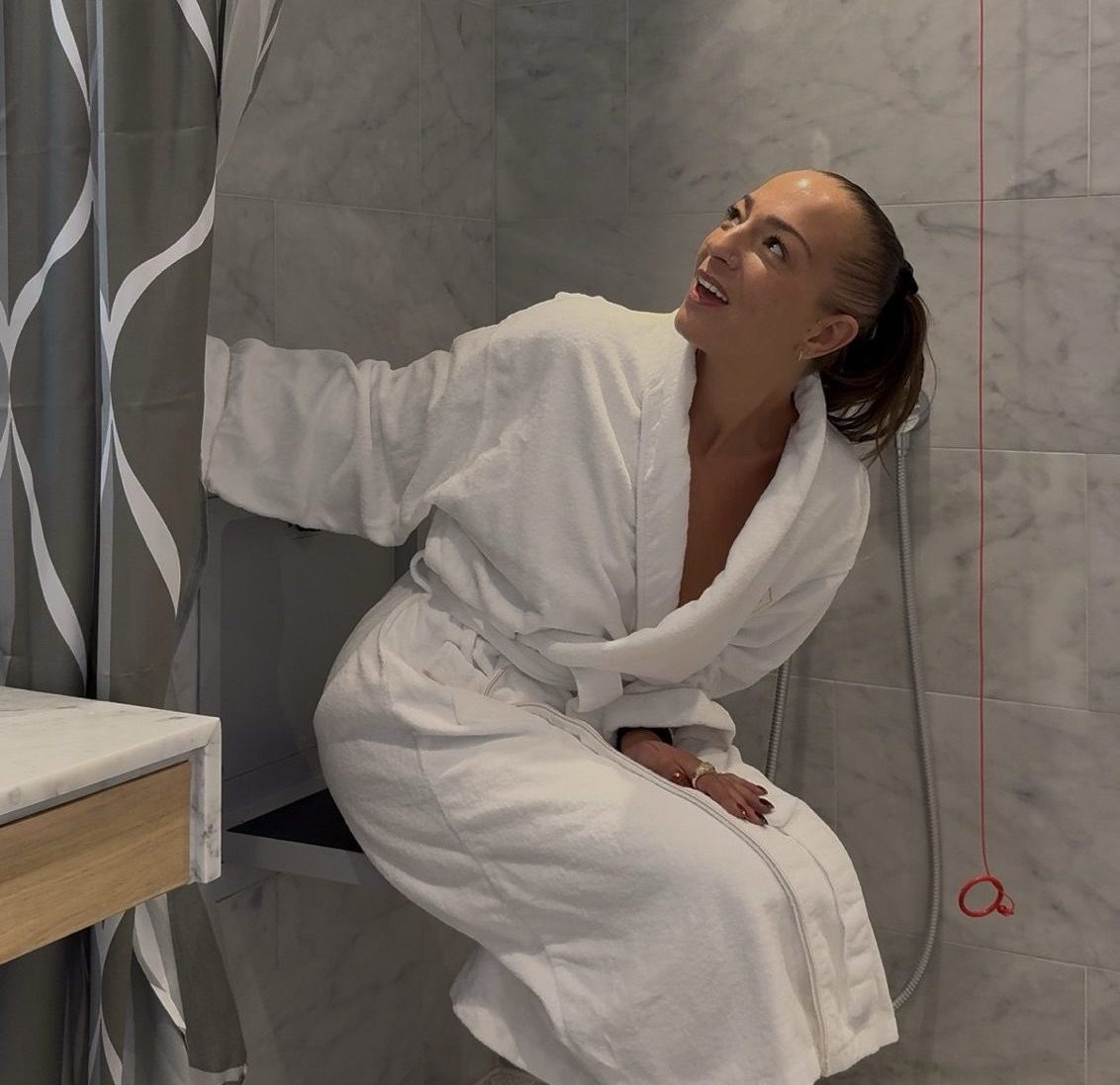
At Royal Lancaster London, I needed a security escort to go to the loo. I made five trips through the kitchens, missed parts of an awards ceremony and was told to bring assistance because I couldn’t safely use the ramp. The hotel later offered me a free stay. I politely declined. Here’s the full story, and why.
At the event the following day, I found myself sitting at the bottom of a very questionable ramp, explaining, yet again, why somebody pushing me up it wasn’t a safe solution.
Somewhere between the bedroom and the event space, being an independent guest, and my bathroom needs had become a discussion.
It’s an odd thing to find yourself defending. I travel extensively, I know my wheelchair and I’m perfectly capable of deciding whether I need somebody to accompany me. Yet at a luxury hotel, while attending a professional event, I was told that if I couldn’t manage the ramp independently, I should bring assistance.
I’d rather hoped the hotel would provide a route I could use.
London had started rather well
I was at the Royal Lancaster for the British Parking Awards on 18 September 2026. I’d stayed at the hotel the night before, having made my first National Express journey to London as a wheelchair user.
The coach journey had worked remarkably well, followed by a black cab from Victoria. I’d arrived feeling comfortable and confident. Having travelled the other side of the world solo, I think a couple of nights in London should have been a relative walk in the park.
Royal Lancaster had already impressed me before I arrived. When I was looking at booking accessible luxury hotel rooms directly in London, its accessible room was available to select online. I could even request a mobile hoist through the booking process, should I require one.
That information gave me confidence. There were parts of the stay I enjoyed very much: the food was lovely, I received some fabulous service and the room worked for my practical needs. A personal emergency evacuation plan, or PEEP, was completed for my overnight stay too.
But being able to use a room and feeling that it has received the same design attention as the rest of a luxury hotel are different parts of the experience.
The shower curtain belongs in this story too
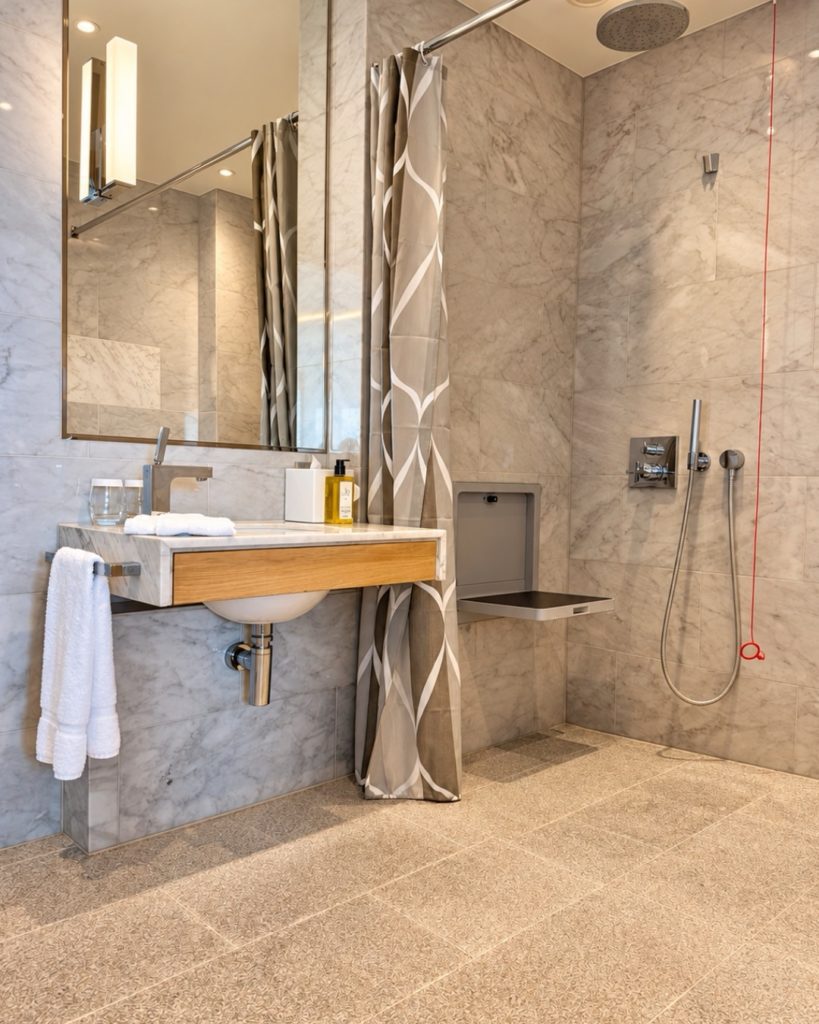
My accessible bathroom had a shower curtain. In a hotel whose accessible-room description promises a stay without compromising on luxury, it felt like a disappointing piece of design.
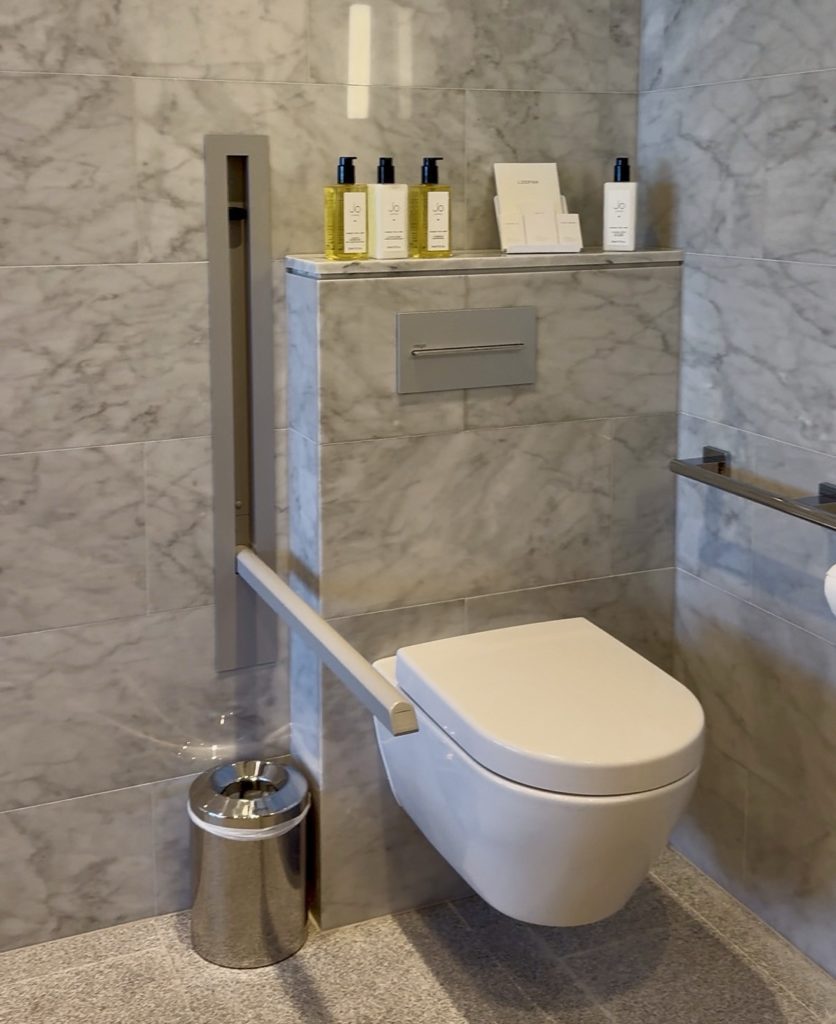
The grab rails and shower seat looked cheap and poorly finished to me, and the folding fittings reminded me of something from a caravan. Those details affected how the whole bathroom felt. I wanted the same care over its appearance and finish that I could see elsewhere in the hotel.
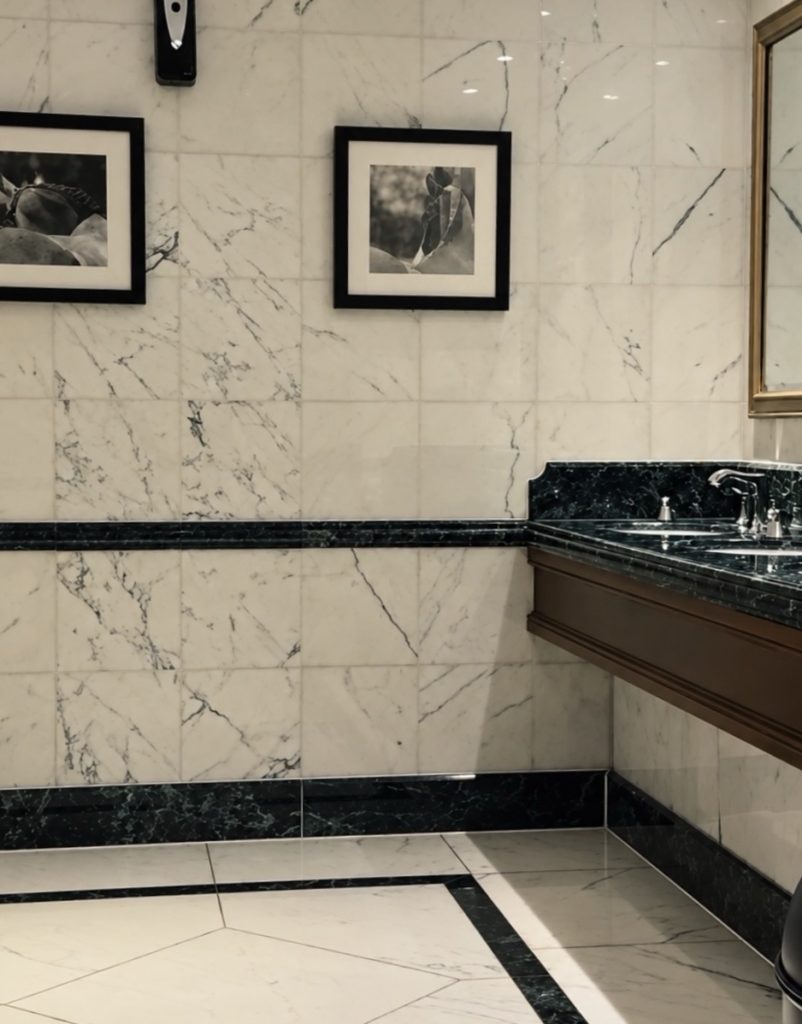
The contrast continued in the public toilets. The ladies’ toilets had lovely tiling, decoration and flowers, and even smelled beautiful. They felt like part of the hotel. The accessible toilet felt clinical to me, much more like a hospital bathroom.
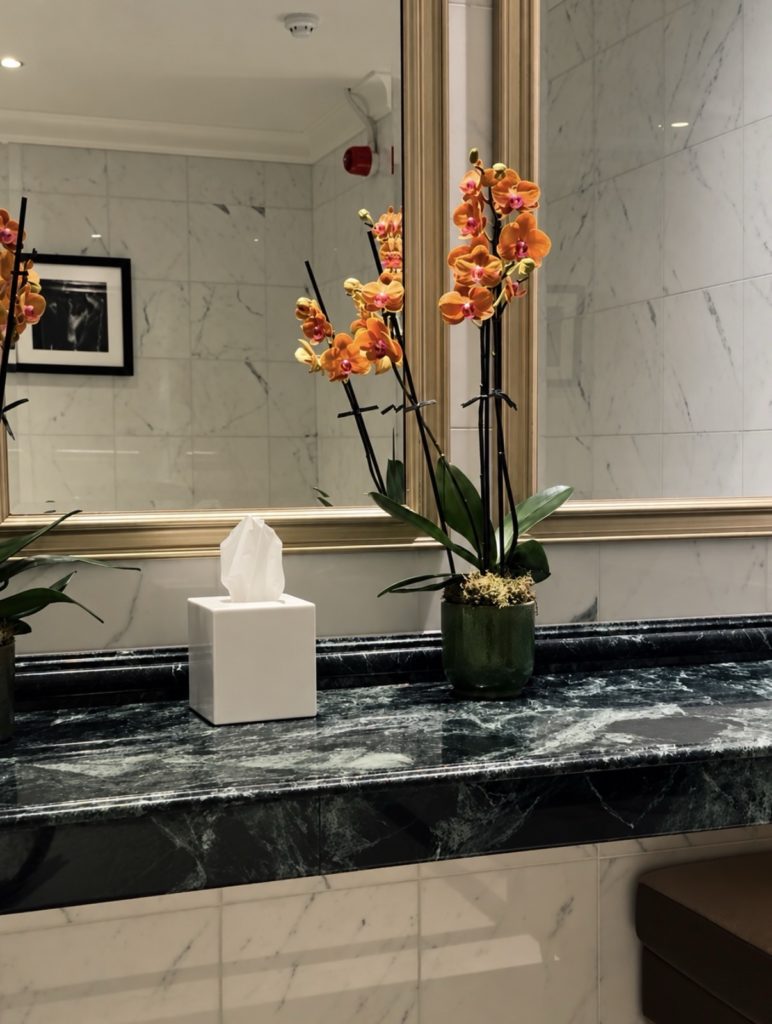
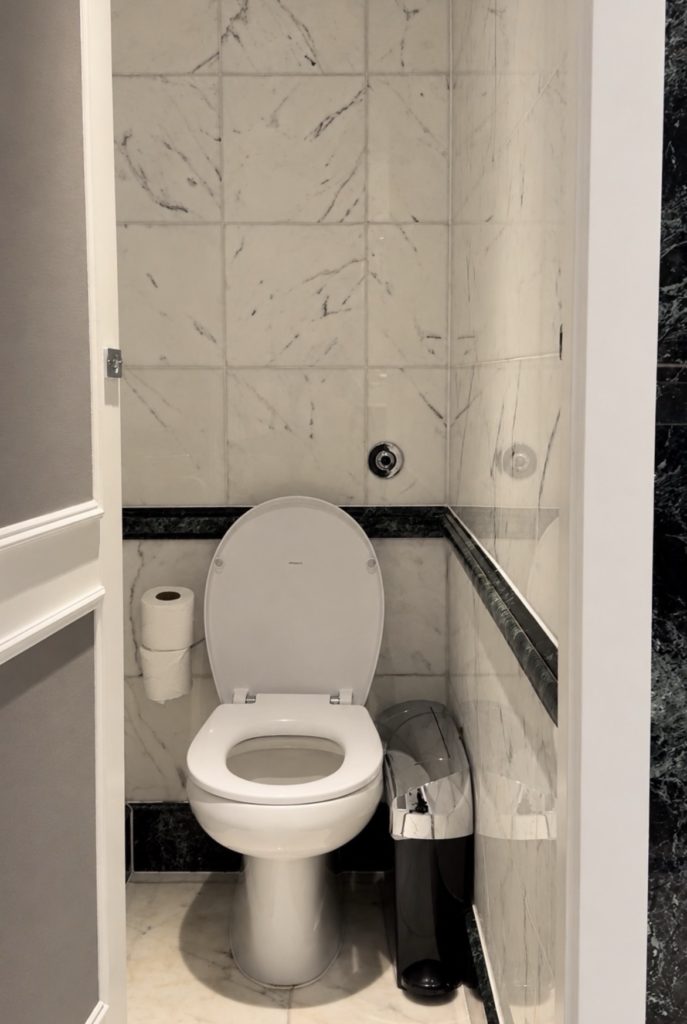
In a later conversation at another hotel, a guest told me he’d stayed at Royal Lancaster several times. He isn’t disabled, but on his most recent visit he’d been allocated an accessible room because it was the only one available. He told me he was “shocked, and disappointed” by the comparison with the standard rooms he knew. That was his account of his stay, but it was striking to hear the difference had stood out to him too.
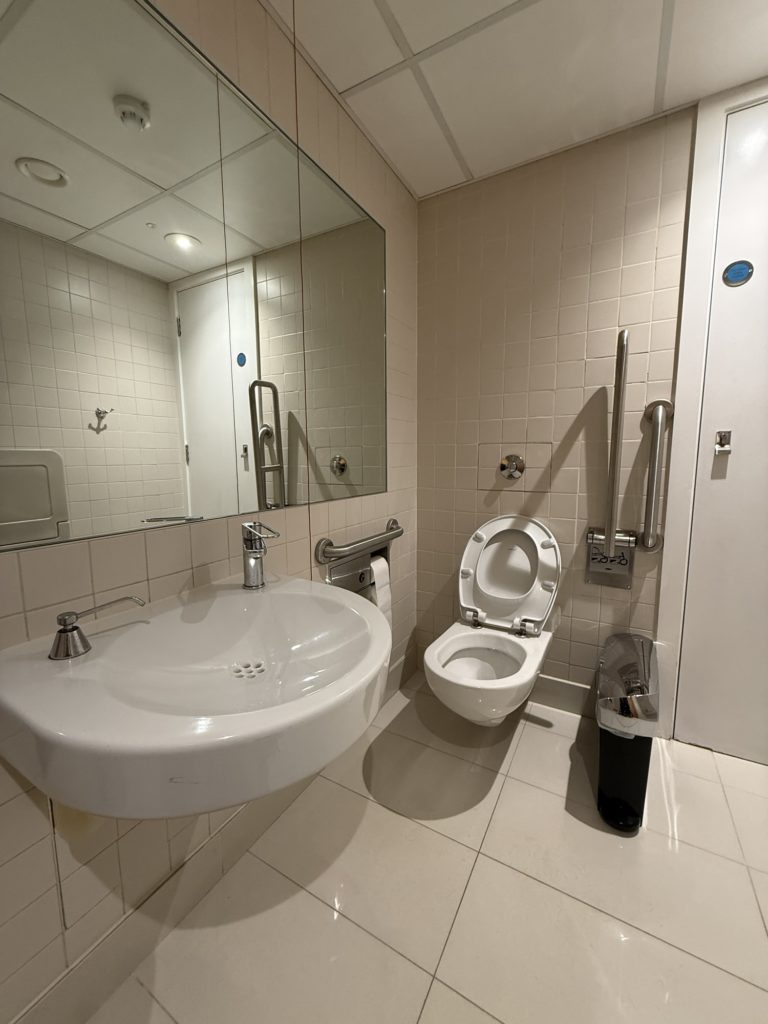
For me, the shower curtain sits within a larger question about the choices a hotel makes for disabled guests. I can need grab rails and still care about the finish, comfort and pleasure of the place I’m staying in. Those expectations come with me when I book a luxury hotel.
Then I met the ramp
I’d come to enjoy an awards ceremony. I hadn’t expected to spend part of it explaining why I couldn’t safely get up and down a ramp.
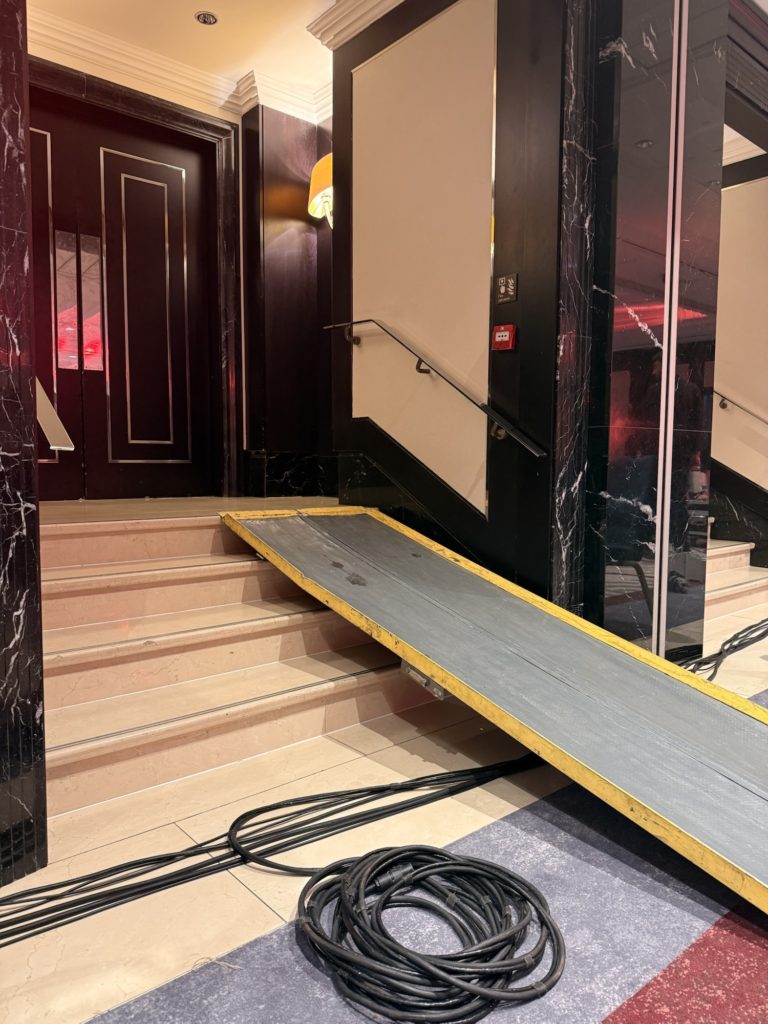
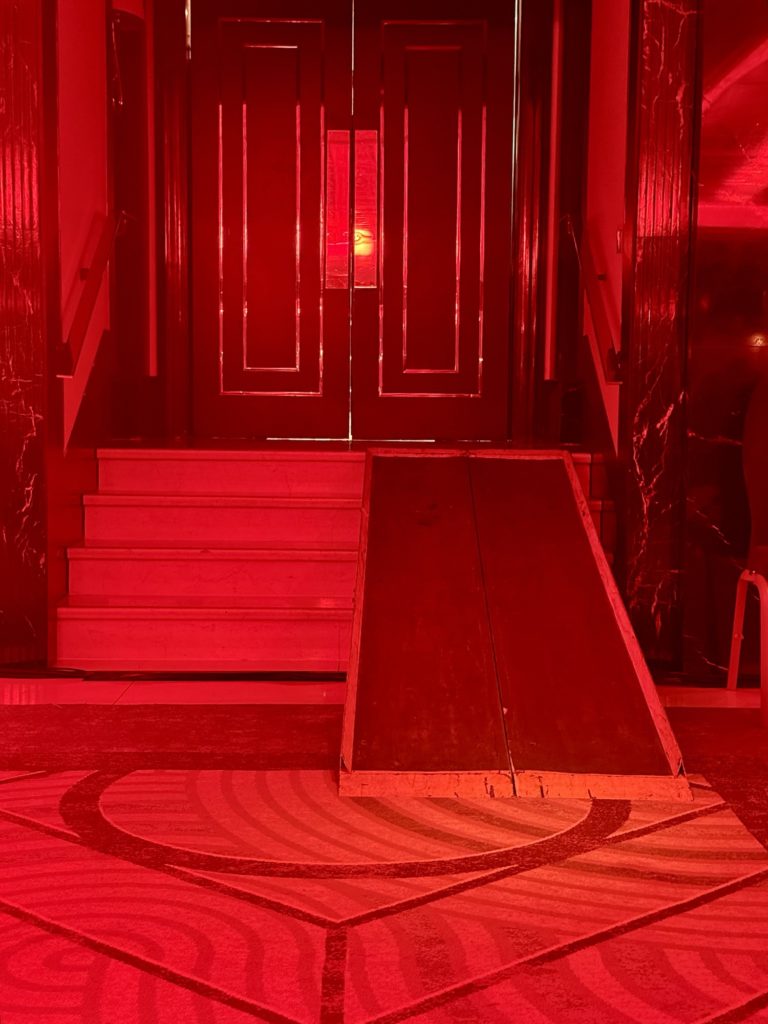
But the ramp serving the event space was far too steep. At different points during the day and evening, I noticed dents in it and cables around it. The whole arrangement looked precarious to me, and trying to use it did very little to reassure me.
As I tried to come down, holding the handrail, my wheels twisted, I swung in to the wall and slid down the ramp awkwardly and hurt my hand. Staff and colleagues saw it happen. My hand shook for about five to ten minutes afterwards, but I was embarrassed and didn’t want to make a scene, so I tried to keep it down.
Once I was at the bottom, I knew I couldn’t safely get back up. Suggestions that somebody could push me started then, so let me explain why that wasn’t a solution I was willing to accept.
My wheelchair doesn’t have push handles. I don’t ordinarily need or want somebody to push me, and I didn’t know what experience the people offering had of pushing a wheelchair. That would have meant trusting someone else to get my chair up a ramp I’d already found unsafe. I wasn’t prepared to take that risk.
The organisers knew I was coming as a wheelchair user. I’d expected to enjoy the event, go to the loo when I needed to and leave safely afterwards. Instead, I was already having to explain why the access being offered wouldn’t work for me.
Who would help me in a fire?
A colleague had seen the initial incident and was checking that I was okay when one of the security guards spoke with us. We asked what would happen if there was a fire.
I’d had a personal emergency evacuation plan for my overnight stay, but I wanted to understand the arrangements for the event. The fire doors we could see were down steps, so I needed to know which route I would use and who would help me.
The guard assured us that somebody would get me out. When I asked who that would be, and what his own role would be in an evacuation, he couldn’t tell me. He said he didn’t know, but repeated that somebody would get me out.
I came away from that conversation feeling dismissed, almost as though I was making an issue to be awkward. I’d already hurt myself trying to use the ramp, and the fire doors we were looking at involved steps. Of course I wanted to know how I’d get out. Being told that somebody would do something, without anyone being able to explain who or how, left me more anxious.
The trip to the loo
There wasn’t an accessible toilet available within that part of the event space. To reach one by the alternative route, I needed a security guard to escort me through working kitchens and staff areas to a service lift, then up two floors.
It couldn’t simply be any member of staff. The security guards were the people with access to that lift via staff only areas, and the guards on duty were all men.
Other guests could get up and go. I had to find a guard, explain that I needed the toilet and wait to be escorted. Along the way, people questioned why I was in those areas, and my need to use the bathroom was explained again.
Over the course of the day, I made that journey through the kitchens five times in total; using uneccessary energy, missing parts of the ceremony along the way. I’d come to take part, and these journeys kept taking me away from it.
I felt like a child asking permission to go for a wee.
At a work event, I shouldn’t have to announce a private bodily need to several people simply to reach a bathroom.
I also manage incontinence. An escorted route and an uncertain wait add a very practical concern to an already awkward situation.
On one occasion, as I came out of the toilet, the guard escorting me was speaking to another member of staff. I heard him say, “She can’t walk, she needs the toilet.”
I was right there. It was embarrassing and humiliating to hear my disability and my private needs discussed as an explanation for my presence.
I can enjoy a chat with practically anyone. I would still like to choose who gets the bathroom update.
I felt I had to prove it
At the end of the event, I went to reception to speak to somebody about what had been happening throughout the day. A manager, two security guards and another member of staff then went back to the ramp with me.
I tried to explain again that it was too steep and that I couldn’t use it safely. I didn’t feel heard or believed. They very much gave the impression that they thought I was overreacting and exaggerating. I felt that the only way they would understand what I was describing was if I showed them, and I was encouraged to demonstrate it again.
By then, I’d already hurt myself and was tired and distressed. Yet I found myself attempting the same ramp again, with an audience, leaning almost completely backwards in my chair to try to control the descent.
I came down fast and narrowly avoided crashing into the tables and chairs we’d been sitting at earlier.
Only after seeing that descent did staff acknowledge the problem and say they hadn’t realised. I’m a 41-year-old woman who knows her wheelchair and what she can safely do in it. I still can’t believe I had to put myself through that again for my explanation to be believed.
And then the suggestions that somebody could push me back up started again. We’d already had this conversation. My chair still had no push handles, and I was still being asked to trust somebody else with a route I couldn’t use safely. Having just seen me come down it, they were asking me to explain my refusal all over again.
“You should have brought assistance”
The guard I’d spoken to about emergency evacuation earlier told me that if I couldn’t manage the ramp independently, I should bring assistance with me. The manager was present.
He also told me he understood my frustration. He was standing at the top of a flight of stairs he could use and I couldn’t.
People were standing around and looking down at me while I tried to advocate for myself. I felt belittled and completely unheard. Being put in that position left me feeling useless and worthless, which is a horrible way to feel at an event you’ve travelled to attend professionally.
An attendee who goes to these awards each year also told me that a Paralympian wheelchair user had raised the same problem two years earlier. They remembered it as the very same ramp. I haven’t independently verified that account, but it was deeply concerning to hear.
“Please just get me a taxi”
Eventually, the manager and a security guard escorted me back through the kitchens towards reception. We were waiting for the lift when voices began getting louder. Two men, who I took to be chefs or kitchen staff, started shouting and swearing at each other, before it escalated into pushing and shoving.
Then the lift arrived. Saved by the bell, and spared the rest of the performance.
I looked up at the manager. She looked at me and shook her head.
“This couldn’t get any worse, could it?” I said.
When I tell this part, I find myself laughing at the sheer absurdity of it. Honestly, it felt like Fawlty Towers. I was still trying to get back to reception, and now this was happening in the kitchen.
By the time we reached reception, I was shaken and just wanted to leave. I asked the hotel to call me a taxi:
“Please just get me a taxi. I need to get out of here.”
I already had a different hotel booked for that night. I just wanted to get into a taxi and go there.
The manager who had accompanied me to the ramp walked me out to the taxi and asked whether I was okay or needed anything else. I told her I had another hotel booked and that I’d be fine.
It was then that she became upset and told me her sister was a wheelchair user. She explained that watching what had happened had been distressing and had made her think of her sister.
That personal connection resonated with me. I felt sorry for her and found myself apologising.
Looking back, that’s a painful part of the evening to remember. I’d been hurt, embarrassed and left defending my own judgement, yet I found myself apologising because somebody else was upset. She was distressed at the thought of her sister in my position, while I was still living through it, trying to make sense of what was happening to me.
I appreciated the concern she showed me outside. I’d also needed to be listened to inside, before I found myself on that ramp for a second time.
The response afterwards
The manager emailed that evening to check how I was feeling, ask about my hand and confirm that she’d escalated the matter to senior management.
My reply on 19 September set out the experience and the questions it had left me with. I also recognised the parts of the stay I’d enjoyed and the care I’d received. I meant those positive comments. They sit alongside what happened at the ramp and how distressed I was when I left.
After a follow-up, a senior member of the hotel’s management team replied on 7 October. The apology was substantial. It recognised that my independence, dignity, privacy and safety had been compromised, and that I should never have been made to feel I needed to bring somebody to assist me.
The response acknowledged that I knew my wheelchair, my abilities and what was safe for me better than anyone else. I appreciated that acknowledgment; it was the understanding I’d needed during the event.
The hotel said it was reviewing the provision of a suitable ramp, investigating the installation of a stair lift and examining its processes and guest journeys. It also said a stair climber had been available and should have been offered.
The response also acknowledged that the answer about emergency evacuation had failed to provide the reassurance I should have received.
What does the accessibility information tell a guest?
I hadn’t known where within the hotel the event would take place. The organisation I was attending with had booked my place and told the event organisers I was a wheelchair user. I’d been reassured that everything was in hand and I should have no concerns. The hotel also knew which event I was attending, as I’d emailed ahead of my arrival.
Looking at the hotel’s meetings and events page now, there’s a direct link to a dedicated AccessAble guide. It records four steps at the Westbourne Suite and makes clear that access into the room isn’t step-free. We now know that isn’t strictly true. They do have what a rickety old portable ramp albeit it not fit for safe use , and apparently a stair climber that not a single person I spoke to had any idea existed.
That detail matters, but so does how it’s used. How does it reach the people booking and running an event, and what has actually been checked before a guest is told everything is in hand?
The hotel’s March 2023 accessibility statement describes staff awareness and step-climber training. Yet I couldn’t get a clear explanation of how I’d leave safely in a fire. Only afterwards did the hotel tell me a stair climber should have been offered.
This is why I want to look beyond a list of facilities. Having a guide or a reassuring score doesn’t, on its own, tell me how well a space or event will work for any person arriving.
Luxury is supposed to remove friction. For me, that includes enjoying the ceremony, going to the loo and leaving safely, without repeatedly having to explain myself.
Is that whole experience being reviewed against the standard the hotel sets itself?
What does the ramp guidance say?
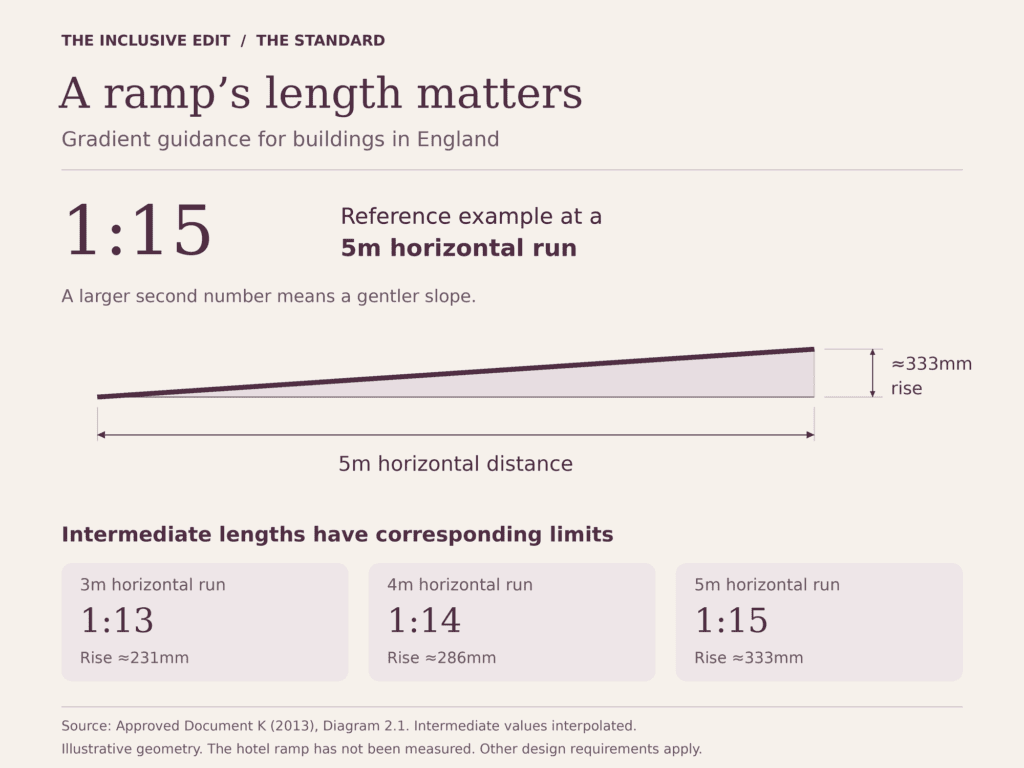
I looked at Approved Document M, Volume 2, which gives access guidance for buildings in England such as hotels. Its aims include being able to use facilities and take part in events, with direct, unobstructed routes to wheelchair-accessible toilets.
For internal ramps, it refers to Approved Document K, Section 2. The maximum gradient shown for a five-metre horizontal run is 1:15: a rise of about 33cm over five metres. Shorter runs have intermediate limits, including 1:13 at three metres and 1:14 at four metres.
The ramp I used spanned the four steps that AccessAble records as 16cm high each, giving a total rise of approximately 64cm. The ramp itself was approximately 3-4 metres long.
Using those published step heights, even allowing a generous five-metre horizontal run would give a gradient of around 1:7.8, almost twice as steep as the 1:15 reference illustrated here. A shorter run would make it steeper still.
The ramp’s precise gradient still needs confirming, but this comparison gives substance to what I’d been trying to explain from the bottom of it. I couldn’t use it safely, and I needed to be believed.
For me, they raise a straightforward question: how had this arrangement been assessed before I was asked to use it? I’d already explained that I couldn’t use it safely. I shouldn’t have had to risk hurting myself again before that was taken seriously.
The invitation I declined
The senior manager offered to welcome me and a guest back for an overnight stay and dinner with his compliments. The invitation was described as a personal gesture, separate from the hotel’s responsibility to address what had happened.
I appreciated the spirit of it, but I declined.
A return stay would still mean travel, time and rearranging work. I didn’t need another night in London, and I wasn’t going to make a separate journey to use it.
A complimentary stay wasn’t why I’d raised these concerns. I wanted to understand how the hotel would address the wider questions my visit had raised about its approach to disabled guests. The bathroom fittings, the contrast between the public toilets, the event access and the way I’d been treated all formed part of that experience.
For me, those details raised questions about service, attitudes and culture, as well as the facilities themselves. What mattered was what would change for the next disabled guest, wherever they were in the hotel, so they could trust the quality and care being promised.
On 8 October, I thanked the hotel for its response and asked for an update on the event routes, toilet access, evacuation arrangements, stair climber and staff guidance once the review had concluded.
The senior manager replied that day, respected my decision and confirmed the review was continuing, promising to ensure I received a meaningful update once it was complete.
As of 1 November 2026, I haven’t received confirmation of completed changes. I’ll update the piece when there is further information.
Why I’m telling the whole story
I would have loved to come home and sing the hotel’s praises. Sharing the incredible examples of accessible luxury I’ve experienced is one of the joys of this work. I know what thoughtful design and a team who understand their guests can make possible, including during my stay at The Ritz-Carlton Abama. I expected more from Royal Lancaster.
The emails from senior management say many of the things I wanted to hear. They acknowledge what went wrong and describe work the hotel intends to do. I appreciated that. But an apology, a review and an invitation to return also feel like a familiar industry response. I’m still left with what happened before those emails were written.
My pain, humiliation and embarrassment have become the experience the hotel can learn from. Once again, it feels as though that has been the price of my expertise. I can explain a guest journey and identify where it breaks down. Having to live through it, hurt myself and demonstrate the problem again is a very different demand to place on me.
It’s exhausting to have to explain these things while you’re trying to enjoy an evening. Disabled people are too often expected to provide that explanation in the middle of the experience that has gone wrong. We should be able to say that something is unsafe for us and have that taken seriously before anybody gets hurt.
My work looks at the whole guest journey
That’s why I follow the whole guest journey in my work: the room, the bathroom, the event, the people you ask for help and the answer you receive. A facility on a website can give you confidence to book. What happens when you arrive determines whether that confidence was well placed.
For me, independence includes deciding when I need help. I’m happy to ask for it. I also need to be believed when I explain why a particular form of help won’t work. The hotel’s response recognised that; I now want to understand what has changed in practice.
The encouragement since I shared part of this story on Instagram has meant a great deal. This experience hurt, and being honest about that matters to me too.
There’s also a real possibility I’ll be invited to the same event next year. The thought of attending it at this hotel already makes me anxious. I’d like to be looking forward to seeing colleagues and enjoying the evening, rather than wondering how I’ll get to the loo or leave the room safely.
About this account
The hotel’s responses of 7 and 8 October are reflected in this article. I declined its offer of a complimentary return stay and dinner.
This account describes my experience in September 2026. Reporting was last checked on 1st November 2026; later alterations haven’t been assessed.
Leave a Reply